Why Desk Work Fuels Sciatica and What You Can Do About It
About 40 % of adults will experience sciatica at some point, and office workers are disproportionately affected because long periods of sitting increase intra‑discal pressure and compress the sciatic nerve. When you sit, the lumbar spine flexes, flattening the natural lordosis, which can aggravate herniated discs, piriformis tightness, or spinal stenosis. The biomechanical strain is amplified by a lack of lumbar support, crossed‑leg posture, and a monitor that forces forward head tilt. To prevent flare‑ups, follow three key ergonomic principles: keep feet flat (or on a footrest) with hips and knees at ~90°, use a chair that provides adjustable lumbar support or a rolled towel, and position the monitor at eye level while keeping the keyboard and mouse within easy reach. Micro‑breaks every 20‑30 minutes to stand, stretch, or walk further reduce nerve compression and promote circulation.
Understanding Why Desk Work Triggers Sciatica
| Trigger | How It Affects Sciatica | Typical Symptoms |
|---|---|---|
| Prolonged static sitting | Increases intra‑disc pressure → disc bulge/herniation irritates sciatic nerve | Radiating low‑back/buttock pain, numbness, tingling, leg weakness |
| Poor posture (slouching, forward head tilt) | Compresses nerve roots, tightens hamstrings/hip flexors → posterior pelvic tilt | Same as above, worsened with forward lean |
| Non‑adjustable chair / crossing legs | Reduces lumbar support, twists pelvis, compresses disc | Acute leg pain, shooting sensations |
| Red‑flag signs (sudden severe weakness, loss of bladder/bowel control, bilateral numbness) | Indicates possible cauda equina or severe nerve compression | Requires immediate medical evaluation |
Key takeaway: The worst sitting position is slouching with unsupported lower back, hips sharply flexed, feet dangling or crossed, as it maximally compresses disc and nerve structures.
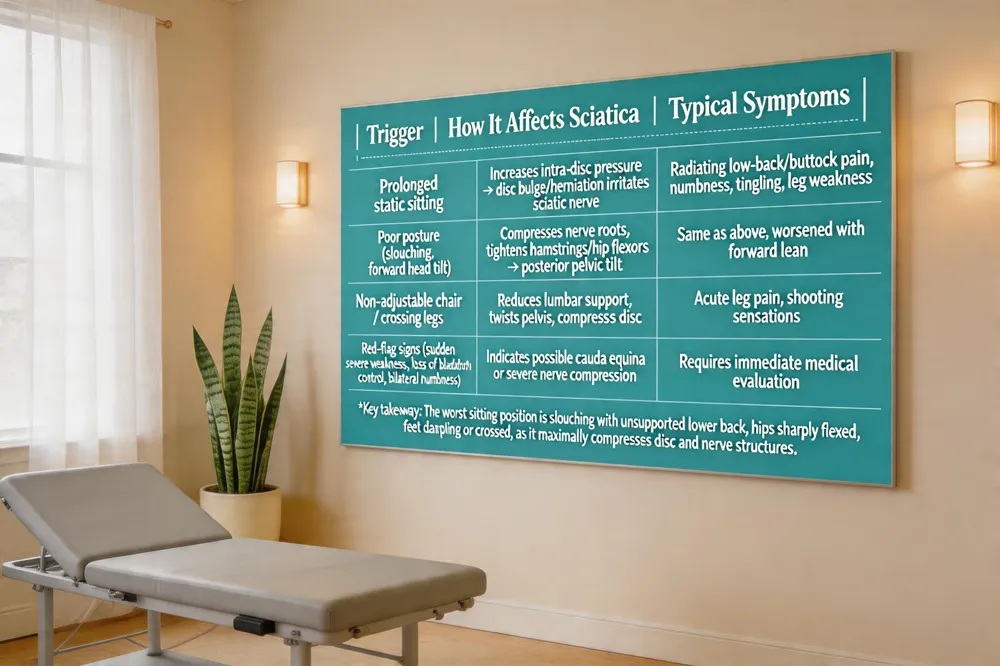 Prolonged static sitting raises intra‑disc pressure, especially in the lumbar region, which can cause disc bulging or herniation that irritates the sciatic nerve. Poor posture—slouching, forward head tilt, and lack of lumbar support—compresses the nerve roots and tightens the hamstrings and hip flexors, creating a posterior pelvic tilt that further pinches the nerve. Common triggers include sitting on non‑adjustable chairs, crossing legs, and staying in one position for more than 30 minutes; red‑flag symptoms are sudden severe leg weakness, loss of bladder or bowel control, or bilateral numbness, which require immediate medical evaluation.
What is the worst sitting position for sciatica? Slouching with unsupported lower back, hips sharply flexed, feet dangling, or crossing legs—this posture compresses discs and twists the spine.
Why did I suddenly develop sciatica? A herniated disc or bone spur suddenly presses on nerve roots, often precipitated by prolonged sitting, heavy lifting, or rapid activity increase.
Can sitting too much trigger sciatica? Yes; prolonged sitting tightens hip flexors and raises disc pressure, aggravating the nerve.
Is sciatica common in office workers? Yes; desk jobs involve long seated periods that increase lumbar loading and nerve irritation.
Sciatica symptoms? Radiating lower‑back or buttock pain, numbness, tingling, or weakness in one leg.
What's the worst thing you can do for sciatica? Heavy lifting, repetitive bending/twisting, or high‑impact activities that increase spinal compression.
Ergonomic Seating and Workspace Setup
| Element | Recommended Adjustment | Rationale |
|---|---|---|
| Chair | Adjustable chair with firm lumbar support; recline 100‑110°; sit back fully | Maintains natural lordosis, reduces disc pressure |
| Lumbar support | Use built‑in cushion or rolled towel behind lower back | Preserves lumbar curvature |
| Monitor height | Top edge at eye level | Prevents forward‑head posture, reduces lumbar flexion |
| Keyboard/mouse | Elbows at ~90°, wrists neutral | Minimizes upper‑extremity strain |
| Foot positioning | Feet flat on floor or footrest; knees at/above hip level (>90° hip angle) | Keeps pelvis neutral, avoids posterior tilt |
| Breaks | Stand/walk 2‑3 min every 30 min; micro‑stretching (cat‑cow, seated twists) | Decompresses discs, activates core muscles |
Quick tip: If using a sofa, sit upright with full back support, feet flat or on a stool, and add a lumbar pillow.
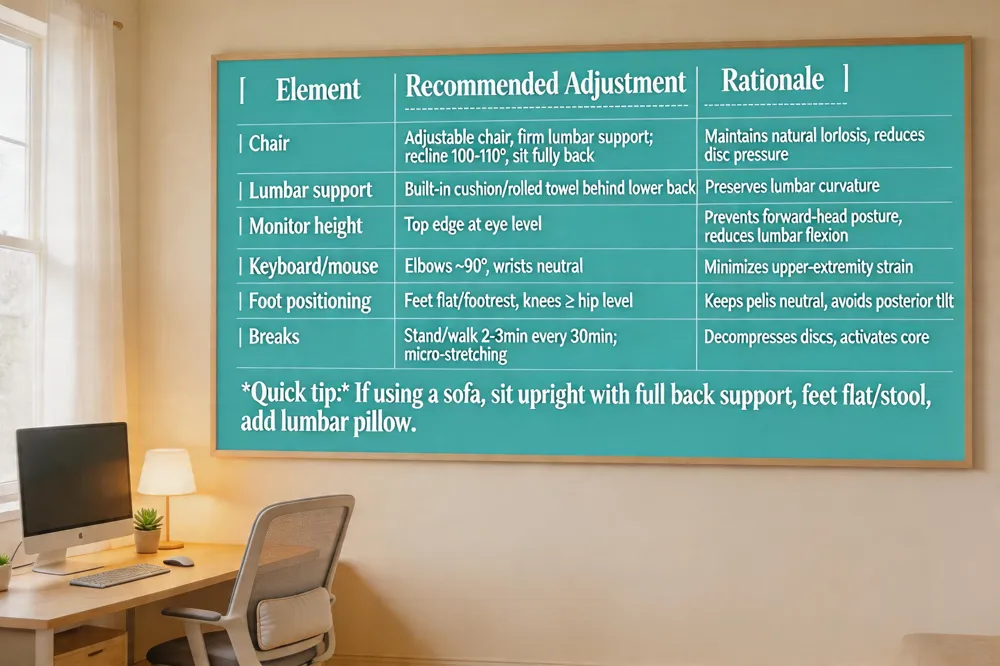 Chair adjustments and lumbar support – Choose an adjustable office chair with firm lumbar support. If the chair lacks built‑in support, place a rolled towel or lumbar cushion behind the lower back to preserve the natural lordosis. Sit with your buttocks firmly against the backrest and keep the back slightly reclined (100‑110°) to reduce disc pressure.
Monitor height and keyboard placement – Position the monitor so the top edge is at eye level; this prevents forward‑head posture and excessive lumbar flexion. Keep the keyboard and mouse within easy reach, allowing elbows to stay at a 90‑degree angle and wrists neutral.
Foot positioning and hip angle – Keep feet flat on the floor or on a footrest; knees should be at or just above hip level, creating an open hip angle >90°. Avoid crossed legs and tucking feet under the chair, which can tilt the pelvis and irritate the sciatic nerve.
How to relieve back pain from sitting at a desk? Adjust the workstation as described, then stand or walk for 2‑3 minutes every 30 minutes. Gentle seated twists, cat‑cow stretches, and shoulder‑blade squeezes keep discs decompressed and core muscles engaged.
How to sit on a sofa with sciatica? Sit upright with full back support, feet flat or on a sturdy stool, knees at hip level, and add a lumbar pillow if needed. Change positions frequently and take brief standing breaks.
How to sit at the office with sciatica? Use the ergonomic chair and foot‑flat posture above, keep shoulders relaxed, and keep the monitor at eye level. Take micro‑breaks every 30‑45 minutes to stand, stretch, or walk.
How do you relieve lower back pain in the office? Combine proper chair setup, monitor height, foot positioning with regular movement breaks, heat or ice therapy, and short desk‑friendly stretches. If pain persists, seek a professional evaluation.
How to help sciatica when sitting at a desk? Maintain neutral pelvis, lumbar support, and hip angle; avoid crossing legs. Incorporate sit‑stand desk use or a chair with adjustable tilt to vary posture throughout the day.
How to fix back pain from an office job? Adopt good posture, use lumbar support, and schedule frequent micro‑breaks for stretches and short walks at least hourly.
Movement Breaks, Sit‑Stand Desks, and Micro‑Break Strategies
| Strategy | Frequency | Duration | Benefits |
|---|---|---|---|
| Micro‑breaks | Every 20‑30 min | 2‑3 min (stand, walk, gentle leg stretch) | Lowers intra‑discal pressure, improves blood flow |
| Sit‑stand desk | Alternate every 30‑60 min | 5‑10 min standing per cycle | Reduces nerve compression, mitigates sedentary risks |
| Transition technique | Slide forward, straighten legs instead of bending at waist | — | Protects sciatic nerve during posture change |
| Stretch routine | Seated piriformis & hamstring stretch | 30‑60 sec per stretch during break | Relieves tightness, improves flexibility |
| Heat/Ice application | As needed (heat for muscle relaxation, ice for inflammation) | 10‑15 min | Adjunctive pain relief |
Average time off work for sciatica: Light‑physical roles ~5 days, moderate work ~3 weeks, heavy labor up to 5 weeks.
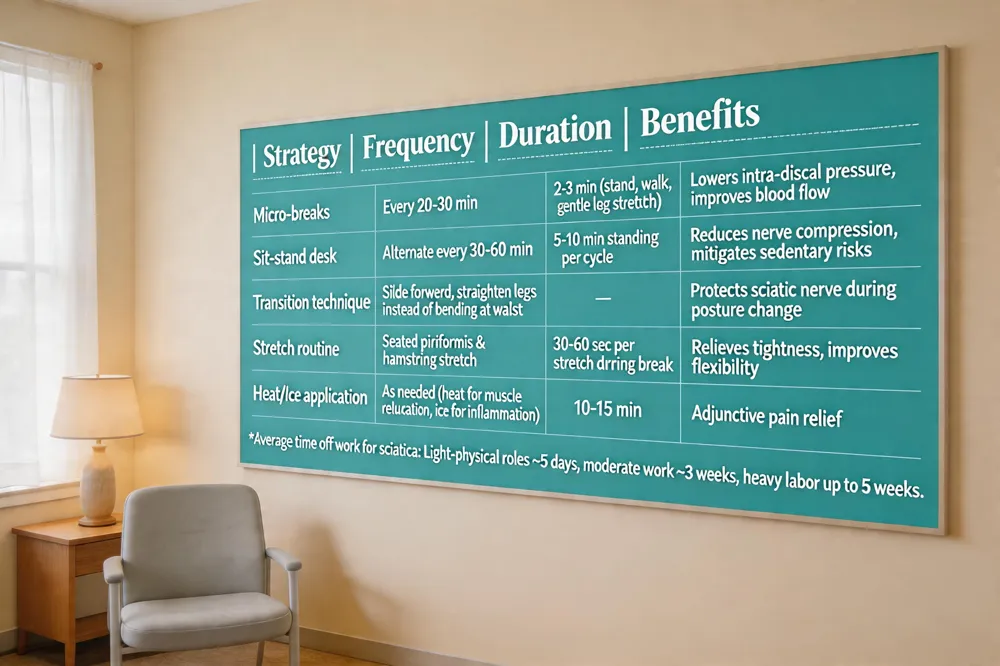 Frequent micro‑breaks are essential for desk workers with sciatica. Aim to stand, walk, or perform gentle leg stretches every 20‑30 minutes; studies show a 2‑3‑minute break reduces intra‑discal pressure and improves blood flow to the lower back. Alternating sitting and standing with a height‑adjustable (sit‑stand) desk further lowers nerve compression and may cut the risk of type‑2 diabetes and cardiovascular disease. When moving from sit to stand, slide forward to the edge of the chair and straighten the legs instead of bending at the waist to protect the sciatic nerve.
How to relieve sciatic pain while at work? Use a sit‑stand desk, change posture every 30‑60 minutes, keep feet flat, monitor at eye level, and apply heat or ice as needed. Perform seated piriformis and hamstring stretches during breaks.
How long should I take off work for back pain? Most acute low‑back pain improves in 2‑6 weeks; a short sick‑leave of a few days is usually sufficient. If pain persists after three weeks, adopt a gradual return‑to‑work plan with modified duties.
Average time off work for sciatica? Sedentary jobs often require 2 days, light‑physical roles about 5 days, moderate work roughly 3 weeks, and heavy labor up to 5 weeks.
Work restrictions for low back pain? Light‑duty: sit with occasional standing, limit lifts to ≤5 lb, change position every 30 min. Moderate‑duty: mix of sit/stand, lift ≤50 lb, avoid prolonged bending. Heavy‑duty: primarily standing/walking, lift ≤100 lb, take 10‑minute hourly breaks.
Should I go to work with back pain? Yes—stay active with a gradual, modified schedule, use ergonomic adjustments, and continue prescribed exercises and medication.
What is the most effective painkiller for sciatica? An NSAID such as ibuprofen is the first‑line drug, targeting inflammation that irritates the sciatic nerve. Use the lowest effective dose for the shortest duration, and combine with heat/ice and movement for optimal relief.
Self‑Care, Stretching, and Adjunctive Therapies
| Self‑care Action | How to Perform | Frequency |
|---|---|---|
| Hip‑flexor stretch | Kneeling lunge, tilt pelvis forward, hold 30 sec | 2‑3 times/day |
| Hamstring stretch | Seated forward bend, keep back straight, hold 30 sec | 2‑3 times/day |
| Piriformis stretch | Lying on back, cross ankle over opposite knee, gently pull, hold 30 sec | 2‑3 times/day |
| Heat pack | Apply warm pack to lower back | 10‑15 min as needed |
| Ice pack | Apply cold pack to inflamed area | 10‑15 min, 3‑4 times/day |
| Hydration | Drink water regularly | Throughout the day |
| Car sitting | Hips at/above knee level, lumbar support, recline 100‑110°, feet flat | Every trip |
Adjunctive therapies: Physical therapy for core stability, yoga for flexibility, massage for muscle tension.
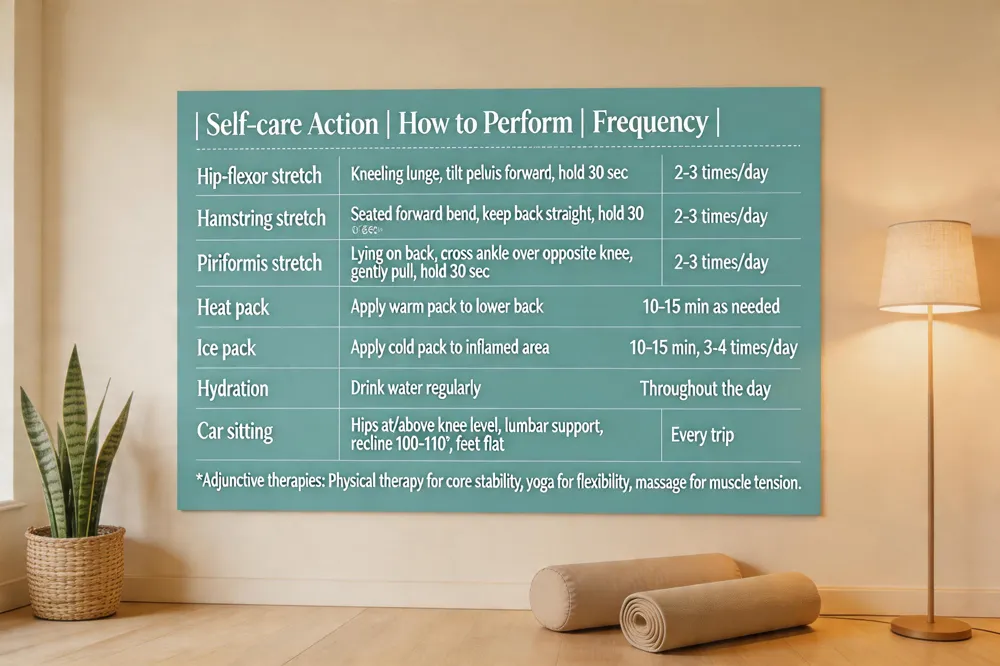 How to prevent sciatica pain when sitting in a car? Keep hips at or above knee level, use lumbar support, recline 100‑110°, keep feet flat, stand every hour, stay hydrated, and use a heat pack on trips.
Medical Management, Treatment Options, and Return‑to‑Work Guidance
| Treatment Level | Options | When to Use |
|---|---|---|
| Conservative | NSAIDs (ibuprofen), ice/heat, self‑care stretching, PT | First‑line, symptoms <4‑6 weeks |
| Interventional | Epidural steroid injection, nerve‑root block, micro‑discectomy | Persistent pain >4‑6 weeks, neurological deficits, red‑flag signs |
| Return‑to‑Work (light duty) | Sit with occasional standing, lifts ≤5 lb, micro‑breaks every 30 min | 2‑4 weeks after symptom onset |
| Return‑to‑Work (moderate duty) | Mix sit/stand, lifts ≤50 lb, avoid prolonged bending | 4‑6 weeks |
| Return‑to‑Work (full duty) | Full ergonomic setup, regular movement, no restrictions | 6‑8 weeks |
Pain management tip: NSAIDs are first‑line; use the lowest effective dose, combine with heat/ice and movement for optimal relief.
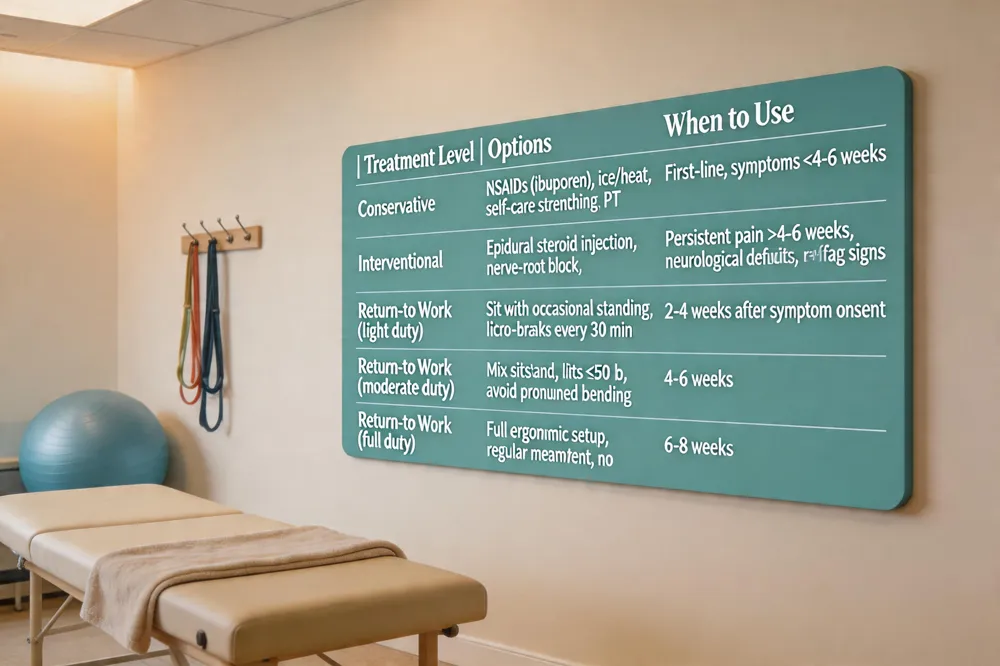 Effective sciatica management first distinguishes conservative from interventional care. Conservative measures—self‑care stretching, heat/ice, NSAIDs, and physical‑therapy for stability—relieve most cases within weeks. Options like epidural steroid injections, nerve‑root blocks, or micro‑discectomy are reserved for persistent pain, weakness, or red‑flag signs.
If symptoms exceed 4‑6 weeks despite self‑care, or new neurological deficits appear, a specialist evaluation is needed. A pain‑medicine physician can review imaging, rule out cauda equina, and design a plan.
Recovery focuses on mobility; light duties after 2‑4 weeks, full duties by 6‑8 weeks with ergonomic adjustments.
Can sciatica be cured?
Yes—most patients recover fully with self‑care, NSAIDs, and physical therapy; refractory cases may need injections or surgery.
Sciatica treatment?
Begin with ice/heat, stretching, activity, NSAIDs, then advance to PT, injections, or surgery if needed.
Pain Management Inglewood, CA?
The California Pain Institute in Los Angeles and clinics such as South Bay Wellness Center provide care.
University Spine and Pain Center – Torrance, CA?
Located at 3111 Lomita Blvd, it offers epidural injections and radiofrequency ablation.
Pacific Pain and Wellness – California?
Based in Torrance, it delivers ketamine infusions and therapies.
Putting It All Together: A Blueprint for Pain‑Free Desk Work
Ergonomic fundamentals for desk workers start with a chair that supports the lumbar curve, feet flat on the floor, knees and hips at 90 degrees, and a monitor at eye level. Micro‑breaks every 20‑30 minutes—standing, walking, or gentle stretching—reduce disc pressure and keep the sciatic nerve from becoming trapped. When pain persists beyond a few weeks, especially with numbness, weakness, or loss of bladder control, seek a healthcare professional for imaging and a tailored treatment plan.
Long‑term spine health combines regular movement, core‑strengthening exercises, weight management, and a supportive mattress. Periodic ergonomic reassessments and adherence to safe lifting techniques further protect against flare‑ups, ensuring sustained, pain‑free productivity. Add brief mindfulness or deep‑breathing pauses to lower tension.