Why Nerve Compression Matters Today
Neuropathic pain affects roughly 7‑10 % of the population, while nerve‑compression syndromes such as carpal tunnel, sciatica, and lumbar radiculopathy add a substantial burden of disability and health‑care costs. The International Association for the Study of Pain defines neuropathic pain as pain caused by a lesion or disease of the somatosensory nervous system, and compression‑related neuropathic pain is a common manifestation of this definition. Recent diagnostic advances—high‑resolution MRI, diffusion‑tensor imaging, and ultrasound‑guided nerve studies studies—improve detection of entrapment sites and guide precise, minimally invasive interventions such as hydro‑dissection and perineural steroid injections. Because many patients remain undertreated, professional guideline consensus now recommends a multimodal, evidence‑based approach: first‑line pharmacologic agents (gabapentinoids, duloxetine), targeted non‑pharmacologic therapies (physical therapy, nerve‑gliding exercises, ergonomic modifications), and, when needed, second‑line options including topical agents, neuromodulation (spinal cord or peripheral nerve stimulation), and regenerative techniques (PRP, stem‑cell‑derived secretomes). This layered strategy maximizes pain relief while minimizing opioid exposure and addresses the complex biological and mechanical contributors to nerve compression today.
Pharmacologic and Non‑Pharmacologic First‑Line Therapies for Neuropathic Pain
First‑line pharmacologic options
| Drug class | Typical dose | Key side effects |
|---|---|---|
| Gabapentinoids (gabapentin) | 1,200‑3,600 mg/day | Sedation, dizziness, weight gain, misuse risk |
| Gabapentinoids (pregabalin) | 300‑600 mg/day | Same as gabapentin |
| Tricyclic antidepressants | Amitriptyline, Nortriptyline | Anticholinergic: dry mouth, constipation, urinary retention |
| SNRIs (duloxetine, venlafaxine) | Duloxetine 60 mg/day, Venlafaxine 150‑225 mg/day | Generally favorable |
Second‑line topical agents
| Agent | Concentration | Mechanism |
|---|---|---|
| Lidocaine patch | 5 % | Sodium channel block |
| Capsaicin patch | 8 % | TRPV1 desensitization |
Third‑line modalities
| Modality | Typical dose/usage | Notes |
|---|---|---|
| IV ketamine | 75‑475 mg sub‑anesthetic | NMDA antagonist, psychotomimetic risk |
| Oral dextromethorphan | Variable | NMDA antagonist |
| Cannabinoids (THC/CBD) | Varies | Modest pain reduction (~0.67 points on 10‑point scale) |
| Botulinum toxin A | Variable | Reduces glutamate, substance P, CGRP release |
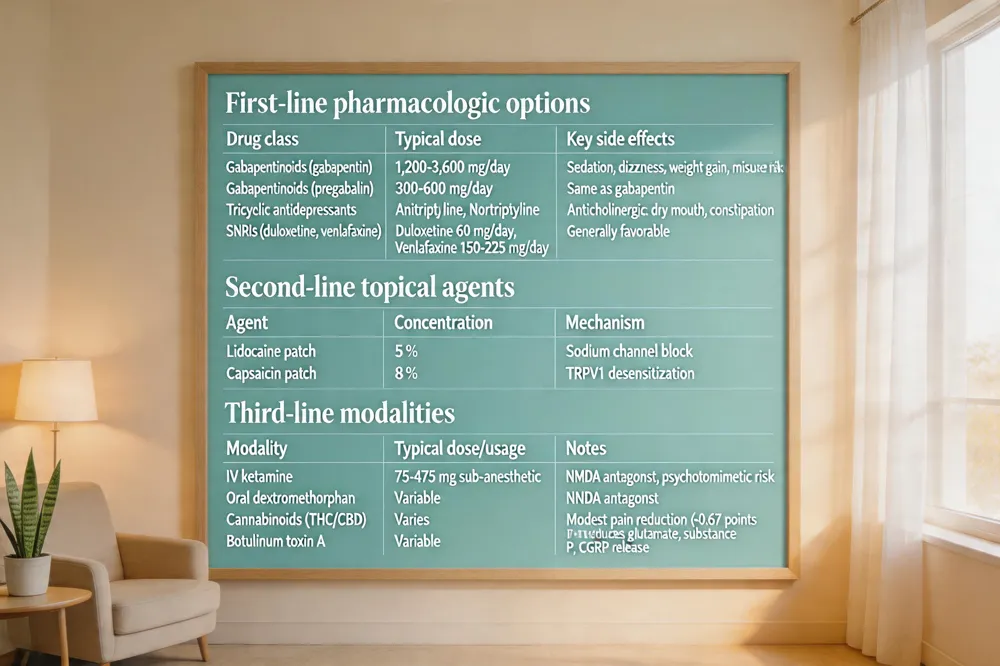 First‑line pharmacologic options – Guidelines recommend gabapentinoids (gabapentin 1,200‑3,600 mg / day; pregabalin 300‑600 mg / day), tricyclic antidepressants (amitriptyline, nortriptyline), and serotonin‑norepinephrine reuptake inhibitors (duloxetine, venlafaxine). Gabapentinoids can cause sedation, dizziness, weight gain and carry a misuse risk; TCAs produce anticholinergic effects (dry mouth, constipation, urinary retention); SNRIs have a more favorable side‑effect profile.
Second‑line topical agents – 5 % lidocaine patches block sodium channels, while 8 % capsaicin patches desensitize TRPV1 receptors, providing localized relief without systemic adverse effects.
Third‑line modalities – IV ketamine (75‑475 mg sub‑anesthetic) and oral dextromethorphan act as NMDA antagonists but may cause psychotomimetic symptoms and require monitoring. Cannabinoids (THC/CBD) yield modest pain reductions (~0.67 points on a 10‑point scale). Botulinum toxin A reduces glutamate, substance P and CGRP release, improving symptoms in post‑herpetic neuralgia and diabetic neuropathy.
Answers to key questions
- Pharmacological management of pain: combines non‑opioids (NSAIDs, acetaminophen), SNRIs, TCAs, and gabapentinoids; opioids are reserved for refractory cases with careful monitoring.
- Most effective treatment for neuropathy: address underlying causes first; duloxetine and gabapentinoids provide the strongest evidence for pain relief, with topical agents as adjuncts.
- Nerve compression medicine: starts with NSAIDs, gabapentinoids, and TCAs, adds physical therapy, splinting, and progresses to corticosteroid injections or minimally invasive decompression if needed.
- 4 P’s of pain: Pain, Purpose, Pacing, Positivity – a framework for coping and treatment planning.
- 5 A’s of pain: Analgesia, Activities of daily living, Adverse effects, Affect, Aberrant drug‑related behaviors – guiding comprehensive pain management.
Home‑Based Care and Self‑Help for Pinched Nerves
Home‑based care checklist
| Step | Action | Rationale |
|---|---|---|
| Rest & protection | Stop aggravating activities, support limb | Prevent further irritation |
| Ice (first 48 h) | 15‑20 min every 2‑3 h | Reduce inflammation |
| Heat (after 48 h) | Warm pack 15‑20 min | Relax muscles, improve blood flow |
| OTC NSAIDs | Ibuprofen or naproxen as directed | Control swelling & pain |
| Ergonomic adjustments | Supportive pillows, neutral spine, splint/brace if needed | Reduce mechanical stress |
| Gentle ROM & nerve‑gliding | Neck rotations, shoulder rolls, wrist flexor stretches, sciatic/median‑nerve mobilizations | Preserve flexibility, avoid stiffness |
| Core strengthening | Planks, bird‑dog | Support spine, lessen future compression |
| Red‑flag monitoring | Watch for worsening weakness, numbness, bladder/bowel loss, severe radiating pain | Prompt referral if present |
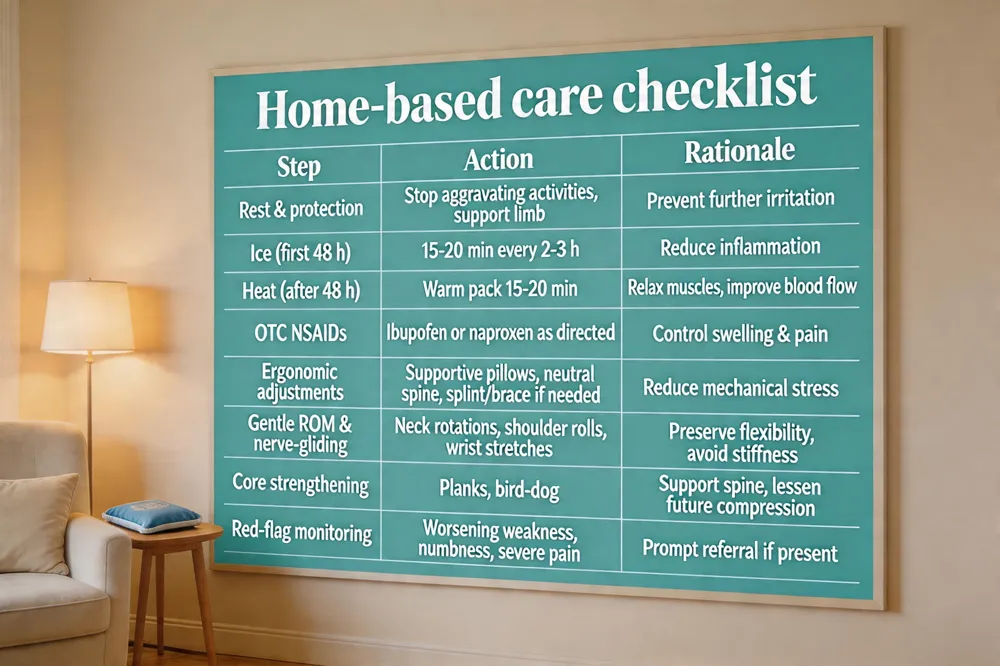 Managing a pinched nerve at home starts with protecting the affected area. Rest the limb and avoid activities that worsen pain; apply ice for the first 48 hours to limit inflammation, then switch to gentle heat to relax muscles and improve blood flow. Over‑the‑counter NSAIDs can help control swelling.
Ergonomic adjustments are essential. Use supportive pillows, maintain neutral spine posture while sitting, and consider a splint or brace for wrist or neck involvement. Keyboard and workstation modifications reduce repetitive strain.
Gentle movement prevents stiffness. Perform pain‑free range‑of‑motion stretches—neck rotations, shoulder rolls, wrist flexor stretches—and nerve‑gliding exercises such as sciatic or median‑nerve mobilizations. Core‑strengthening (planks, bird‑dog) supports the spine and reduces future compression.
Seek professional evaluation if symptoms persist beyond a week, worsen, or are accompanied by significant weakness, numbness, loss of bladder/bowel control, or severe radiating pain. Early referral to a pain‑medicine specialist allows imaging, electrodiagnostic testing, and timely interventions (physical therapy, targeted injections, or minimally invasive decompression) to prevent permanent nerve damage.
Interventional Procedures, Neuromodulation and Specialist Networks
Interventional options overview
| Procedure | Indication | Key benefits |
|---|---|---|
| US‑guided hydrodissection | Nerve compression with perineural fibrosis | Rapid symptom relief, low infection risk |
| Steroid injection | Acute inflammation around compressed nerve | Anti‑inflammatory, short‑term pain control |
| Percutaneous nerve release | Focal entrapment note.g., carpal tunnel) | Minimally invasive, outpatient setting |
| Spinal cord stimulation (SCS) – high‑frequency 10 kHz | Refractory back or limb neuropathic pain | ≥50 % pain reduction, preserving motion |
| Dorsal root ganglion (DRG) stimulation | Focal neuropathic pain (e.g., groin, foot) | ~71 % responder rate |
| Peripheral nerve stimulation (PNS) | Localized nerve compression | Durable relief comparable to surgical decompression |
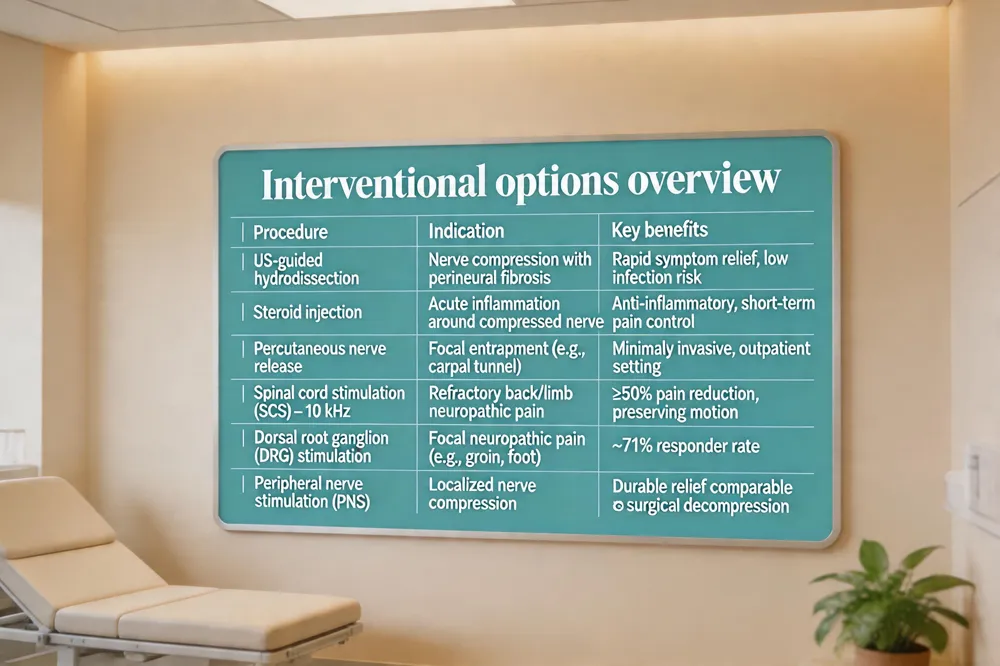 US‑guided hydrodissection, steroid injections and percutaneous nerve release have become frontline minimally invasive options for nerve compression, offering rapid symptom relief with lower infection risk than open surgery. Spinal cord stimulation (SCS), especially high‑frequency 10 kHz waveforms, provides ≥50% pain reduction in a majority of refractory back‑pain patients, while dorsal root ganglion (DRG) stimulation targets focal neuropathic pain with a 71% responder rate. Peripheral nerve stimulation (PNS) delivers low‑level electrical pulses to compressed nerves, yielding durable relief comparable to surgical decompression. Los Angeles hosts world‑class pain specialists: Dr. Laura G. Audell (Cedars‑Sinai), Dr. Hayley Osen and Dr. Najmeh P. Sadoughi (UCLA Health), Dr. Jerry Markar (North Hollywood), and the Santa Monica Pain Medicine team (Drs Ferrante, Hsu, Ing). UCLA’s Comprehensive Pain Center combines diagnostics, medication management, and interventional procedures such as epidurals and SCS. Cedars‑Sinai Pain Management features Dr. Vijjeswarapu, Dr. Wittnebel, and Dr. Blumenfeld, offering multidisciplinary care. The California Pain Institute in Beverly Hills and Van Nuys delivers integrated medication, regenerative therapies, and neuromodulation, ensuring comprehensive, patient‑centered pain relief across the Greater Los Angeles region.
Regenerative Medicine, Gene Therapy and Emerging Molecular Treatments
Emerging therapies snapshot
| Modality | Mechanism | Clinical stage | Potential advantage |
|---|---|---|---|
| MSC‑exosome therapy | Delivery of neurotrophic factors (NGF, BDNF, GDNF) | Phase I/II pilot trials | Accelerates axonal regrowth, modulates immunity |
| AAV‑CaV3.2 gene therapy | Peptide blockade of CaV3.2 calcium channels in DRG neurons | Phase I (NCT04567890) | Long‑lasting, localized analgesia without numbness |
| Mitochondrial transfer via satellite glial cells | Restoration of neuronal energy homeostasis | Pre‑clinical animal models | Raises pain thresholds, promotes regeneration |
| Combination approaches (gene + mitochondrial support) | Synergistic repair pathways | Future trials planned | May enhance speed and durability of nerve recovery |
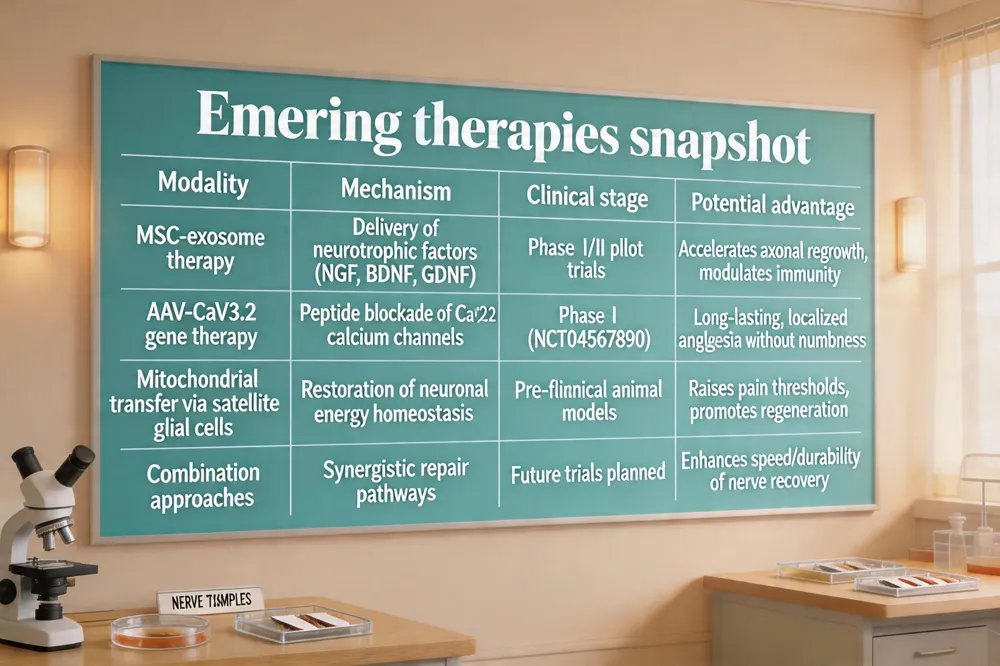 Stem‑cell and exosome therapies for nerve repair – Mesenchymal stem cells (MSCs) and their secreted exosomes deliver neurotrophic factors (NGF, BDNF, GDNF) that accelerate axonal regrowth and modulate immune responses. Clinical pilots show up to a 45% improvement in nerve conduction velocity and reduced pain scores when MSC‑laden conduits bridge gaps >3 cm.
Peptide‑based CaV3.2 nerve‑block gene therapy – An adeno‑associated virus (AAV) vector delivers CaV3.2‑blocking peptides to dorsal‑root‑ganglion neurons, silencing pain‑specific calcium channels without numbness. Animal studies report analgesia lasting 6‑12 months, offering a non‑opioid, localized alternative.
Mitochondrial transfer and satellite glial cell research – Satellite glial cells shuttle healthy mitochondria to sensory neurons via tunneling nanotubes, restoring energy homeostasis and dampening chronic pain signaling. Restoring this transfer in diabetic and chemotherapy‑induced neuropathy models raises pain thresholds and promotes regeneration.
Clinical trials and future directions – Ongoing Phase I/II trials (e.g., NCT04567890) evaluate AAV‑CaV3.2 injections in sciatica, while multicenter studies test MSC‑exosome injections adjacent to compressed nerves. Combining gene‑therapy with mitochondrial support may synergistically accelerate repair.
Questions answered – New treatments for nerve damage include MSC/exosome therapy and CaV3.2 gene‑block. Nerves can regenerate, typically ~1 mm/day; early intervention improves outcomes. Supplements such as α‑lipoic acid, acetyl‑L‑carnitine, B12, curcumin, and vitamin E support regeneration. Emerging research on Sarm1, nerve‑gliding exercises, and satellite‑glial mitochondrial transfer further informs future protocols.
Patient Resources, Lifestyle Strategies and Self‑Management Tools
Self‑management toolbox
| Resource / Strategy | Description |
|---|---|
| PDFs | VA Pocket Guide (2022) & UC Davis “Pain Self‑Management Plan” – assessment tools, medication algorithms, pacing, exercise, nutrition |
| Vitamin B12 supplementation | High‑dose cyanocobalamin or methylcobalamin → supports myelin formation & reduces neuropathic pain |
| Mental‑pain techniques | Deep‑breathing → mindfulness → guided imagery → CBT for thought restructuring |
| 4 P’s of chronic pain | Pain, Purpose, Pacing, Positivity – framework for coping |
| 5 A’s of pain management | Analgesia, Activities of daily living, Adverse effects, Affect, Aberrant drug‑related behaviors |
| UCLA Pain Management locations | Downtown LA (700 W 7th St., Suites S270‑D & S270‑C), Santa Monica (1245 16th St., Suite 225), North Hollywood (4343 Lankershim Ave., Suite 200), Encino (15503 Ventura Blvd., Suites 150‑170‑240), Torrance (3500 Lomita Blvd., Suite M100) |
| Non‑pharmacologic relief | Low‑impact exercise, heat/cold therapy, TENS, PT, massage, acupuncture, biofeedback |
| Strongest natural analgesic | Curcumin (turmeric) – anti‑inflammatory comparable to OTC NSAIDs |
| Japanese approach | Goshajinkigan (Kampo formula) – improves numbness & cold sensation in diabetic neuropathy |
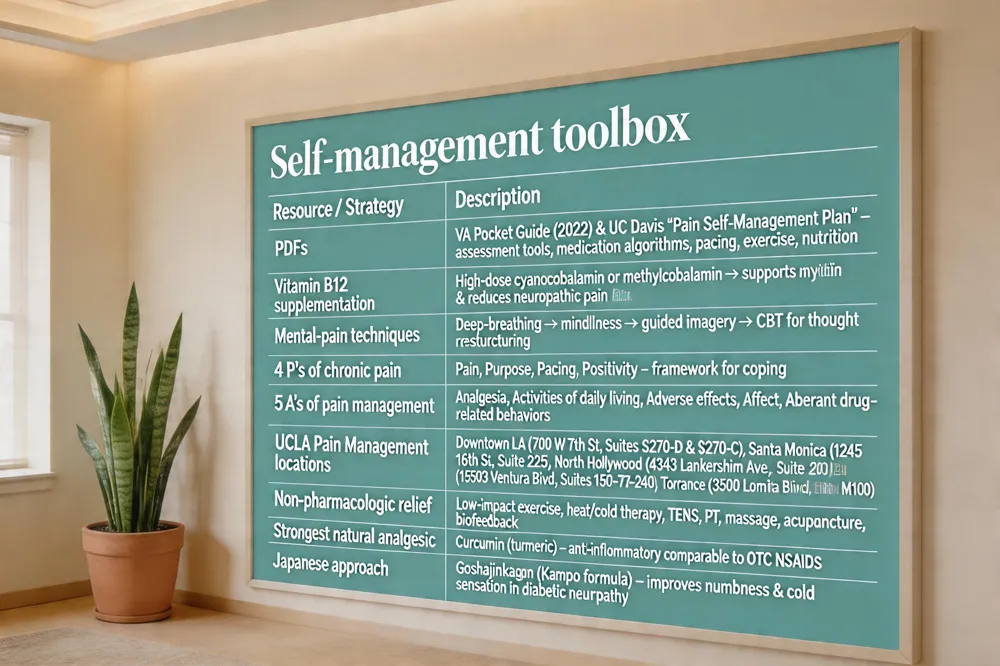 Helpful PDFs are available for patients who want a clear, evidence‑based roadmap to chronic pain. The VA’s Pocket Guide for Clinicians (2022) and UC Davis’s “Pain Self‑Management Plan” PDF can be downloaded from their websites and cover assessment tools, medication algorithms, pacing, exercise, and nutrition.
Vitamin support – B‑12: B‑12 is the nutrient most strongly linked to reversing neuropathy because it is essential for myelin formation and nerve regeneration. High‑dose cyanocobalamin or methylcobalamin, often paired with other B‑complex vitamins, has been shown to reduce pain, tingling, and numbness in diabetic and non‑diabetic neuropathy.
Mental pain control: Begin with deep‑breathing to trigger the relaxation response, then practice mindfulness or guided‑imagery meditation to shift attention away from discomfort. Cognitive‑behavioral techniques help identify unhelpful thoughts (“My pain will never end”), evaluate their accuracy, and replace them with realistic, empowering statements. Consistent practice lowers perceived pain intensity and medication reliance.
4 P’s of chronic pain – Pain, Purpose, Pacing, Positivity – provide a framework for understanding and managing daily symptoms.
5 A’s of pain management – Analgesia, Activities of daily living, Adverse effects, Affect, Aberrant drug‑related behaviors – guide comprehensive treatment planning.
UCLA Pain Management locations – Downtown Los Angeles (700 W 7th St., Suites S270‑D & S270‑C), Santa Monica (1245 16th St., Suite 225), North Hollywood (4343 Lankershim Ave., Suite 200), Encino (15503 Ventura Blvd., Suites 150‑170‑240), and Torrance (3500 Lomita Blvd., Suite M100).
Pain relief without pills – Low‑impact exercise (walking, swimming, yoga) (heat/cold therapy, tENS units, physical therapy, massage, acupuncture, and biofeedback) all provide drug‑free analgesia.
Strongest natural pain reliever – Curcumin (turmeric) has the most robust anti‑inflammatory and analgesic effects among natural agents, comparable to some OTC NSAIDs.
Japanese approach – Goshajinkigan, a traditional Kampo formula of ten herbs, is used to improve numbness, cold sensation, and limb pain in diabetic neuropathy.
Putting It All Together – A Roadmap for Relief
Early, of nerve compression and neuropathic pain is critical. High‑resolution MRI, ultrasound, and nerve conduction studies now pinpoint the exact site of entrapment, allowing clinicians to intervene before irreversible damage occurs. A multimodal plan that blends physical therapy, ergonomic adjustments, and targeted exercises—such as nerve‑gliding and core‑strengthening—forms the foundation of care and reduces reliance on medication.
Pharmacologic options are individualized: first‑line gabapentinoids (gabapentin 1,200–3,600 mg/day or pregabalin 300–600 mg/day), tricyclic antidepressants, or serotonin‑norepinephrine reuptake inhibitors address the neuropathic component, while short‑term NSAIDs or low‑dose corticosteroids control inflammation. When pain persists, second‑line interventions such as ultrasound‑guided hydrodissection, perineural steroid or hyaluronic acid injections, and peripheral nerve stimulation provide focused relief without systemic side effects. Emerging regenerative therapies—including platelet‑rich plasma, mesenchymal stem‑cell injections, and the novel AAV‑delivered CaV3.2 peptide nerve‑block—show promise for long‑lasting symptom reduction.
Empowering patients is essential. Education on posture, ergonomic workstations, and activity pacing, combined with self‑management tools like heat‑cold therapy, mindfulness‑based stress reduction, and wearable feedback devices, enables individuals to actively participate in their recovery and maintain functional improvement over the long term.