Why Understanding Medicare Pain Coverage Matters
Medicare provides a layered safety net for pain‑management care. Part A covers inpatient services—hospital stays, skilled‑nursing facility care, and hospice—where pain relief is delivered during admission. Part B handles the bulk of outpatient therapy: physical and occupational therapy, acupuncture for chronic low back pain, chiropractic care (when correcting a subluxation), behavioral‑health integration, depression screenings, and opioid‑use‑disorder treatment. Prescription pain meds fall under Part D, which may also offer Medication Therapy Management programs to promote safe opioid use. For most Part B services, beneficiaries pay 20 % of the Medicare‑approved amount after meeting the annual deductible; additional copayments or coinsurance can apply in hospital outpatient clinics. Annual depression screenings are covered at no cost when the provider accepts assignment. Understanding these components helps patients anticipate out‑of‑pocket expenses, coordinate with providers, and maximize the benefits of their Medicare plan while managing pain effectively.
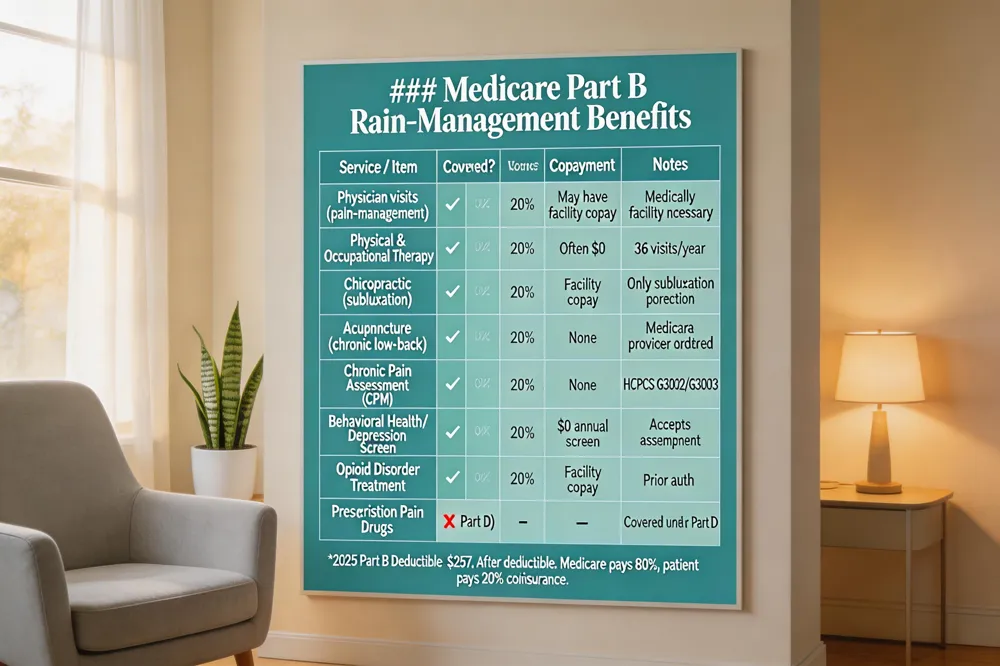
Medicare Part B Pain‑Management Benefits
Medicare Part B Pain‑Management Benefits
| Service / Item | Covered? | Coinsurance after Deductible* | Typical Copayment (if any) | Notes |
|---|---|---|---|---|
| Physician visits (pain‑management) | ✅ | 20 % of Medicare‑approved amount | May have a fixed facility copayment in hospital outpatient department | Must be medically necessary |
| Physical & Occupational Therapy | ✅ | 20 % | Often $0 copayment in a clinic setting | Up to 36 visits per year typical |
| Chiropractic care (subluxation correction) | ✅ | 20 % | Facility copayment may apply | Only when correcting subluxation |
| Acupuncture (chronic low‑back pain) | ✅ | 20 % | None in most clinics | Must be ordered by a Medicare‑enrolled provider |
| Chronic‑pain assessment & coordination (CPM) | ✅ | 20 % | None | Uses HCPCS G3002/G3003; requires validated pain scale |
| Behavioral‑health integration & depression screening | ✅ | 20 % | None for annual depression screen | No cost when provider accepts assignment |
| Opioid‑use‑disorder treatment (Medication‑Assisted Treatment) | ✅ | 20 % | May have facility copayment | Requires prior authorization for some meds |
| Prescription pain drugs | ❌ (Covered under Part D) | – | – | Part D or or MTM programs may lower out‑of‑pocket |
*Beneficiaries must first meet the 2025 Part B deductible ($257). After the deductible, Medicare pays 80 % and the patient pays the remaining 20 % coinsurance.
 What services are covered
Medicare Part B pays for medically necessary outpatient pain‑management services such as physician visits, physical and occupational therapy, chiropractic care (when correcting a subluxation), acupuncture for chronic low‑back pain, chronic‑pain assessment and coordination, behavioral‑health integration, depression screening, and opioid‑use‑disorder treatment. Prescription pain drugs are covered under Part D, and many plans offer Medication Therapy Management programs.
Coinsurance, deductible, and copayments
Beneficiaries must first meet the annual Part B deductible (2025: $257). After that, Medicare pays 80 % of the Medicare‑approved amount and the patient pays the remaining 20 % coinsurance (beneficiaries typically pay a 20% coinsurance after meeting the Part B deductible). For services rendered in a hospital outpatient clinic or department, an additional fixed copayment may apply. Annual depression screenings are covered at no cost when the provider accepts assignment. Copayment amounts and additional coinsurance vary by facility type and whether the provider accepts assignment.
In‑hospital vs. outpatient billing
Pain‑management services provided in an outpatient clinic are billed under Part B with the 20 % coinsurance after the deductible. When the same services are delivered in a hospital outpatient department, Medicare still pays the approved amount, but the beneficiary may also owe a facility‑based copayment or additional coinsurance. Inpatient pain care (e.g., post‑surgical pain control) is covered by Part A.
Is pain management covered by insurance?
Yes—most U.S. health‑insurance plans, including Medicare Part B, cover pain‑management services when deemed medically necessary. However, services such as routine massage therapy are not covered by Original Medicare.
Which of the following is not covered by Original Medicare for chronic pain?
Massage therapy is not covered by Original Medicare for chronic‑pain treatment.
Pain management near me that accept Medicare
The California Pain Institute in Los Angeles accepts Medicare for a full range of pain‑management services.
Will pain management give pain meds?
Yes. Pain‑management specialists prescribe oral and injectable medications as part of a step‑wise treatment plan, integrating them with non‑pharmacologic therapies.
Is pain management covered by Medicare?
Yes. Part B covers outpatient services; Part D covers prescription drugs. Medicare Advantage plans must offer at least the same benefits.
Does Medicaid cover pain management?
Yes, but coverage varies by state. In California, Medi‑Cal covers many pain‑management services, including therapy and certain injections.
Medicare guidelines for pain‑management injections 2025
Injections such as epidural steroid shots and facet‑joint blocks are covered when medically necessary, after meeting the $257 deductible and paying 20 % coinsurance. Frequency limits and prior‑authorization requirements apply.
What pain management does Medicare cover?
A broad spectrum including PT/OT, chiropractic, acupuncture, chronic‑pain programs, behavioral‑health services, and prescription medications (via Part D).
Out‑of‑Pocket Costs When You’re Uninsured
Out‑of‑Pocket Costs When Uninsured (California)
| Service | Typical Cost Range (USD) | Frequency (Typical) | Comments |
|---|---|---|---|
| First pain‑management office visit | $119 – $176 | One‑time (new patient) | Includes evaluation and treatment plan |
| Follow‑up office visit | $75 – $150 | Every 4‑6 weeks | May be shorter visit |
| Epidural steroid injection / nerve block | $500 – $2,000 per session | 1‑3 times per year (depends on condition) | Includes imaging guidance |
| Radiofrequency ablation (advanced) | $3,000 + per session | 1‑2 times per year | Higher cost, durable pain relief |
| Prescription pain medication | $10 – $200 per month | Monthly | Varies by drug class and dosage |
| New‑patient office visit (MDsave data) | $127 – $594 | One‑time | Wide range reflects provider location and complexity |
Key Takeaway: Uninsured patients can expect monthly out‑of‑pocket expenses ranging from a few hundred dollars to several thousand dollars, depending on the mix of visits, procedures, and medications.
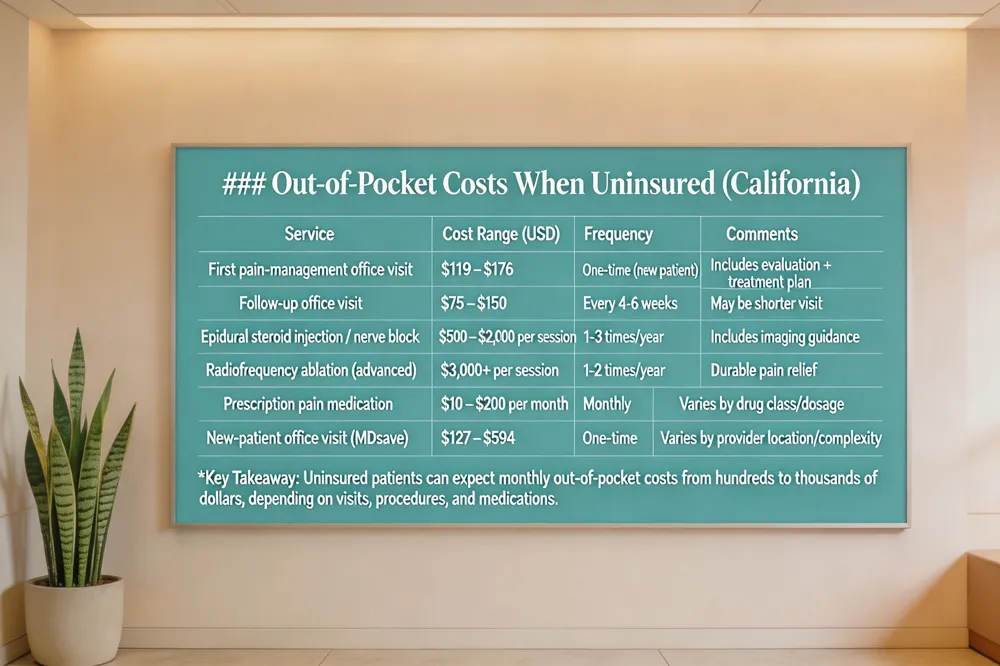 Standard office‑visit fees in California typically range from $119 to $176 for a first pain‑management appointment, with follow‑up visits often falling between $75 and $150. Procedural and interventional costs vary widely: a basic epidural steroid injection or nerve block may cost $500‑$2,000 per session, while more advanced services such as radiofrequency ablation can exceed $3,000. Prescription‑drug expenses add another $10‑$200 per month, depending on the medication and dosage.
How much is pain management without insurance?
Uninsured patients can expect total monthly out‑of‑pocket expenses of several hundred dollars to a few thousand dollars, based on the mix of office visits, procedures, and medications required.
How much does pain management cost in California?
A new‑patient pain‑management office visit in California ranges from $127 to $594, according to MDsave pricing data.
These figures are averages; actual costs may differ based on the provider’s rates, geographic location, and the specific services rendered.
Obtaining Pain Medications Safely
Safe Prescription Process for Pain Medications
| Step | Description | Who Is Involved | Safety Checks |
|---|---|---|---|
| 1. Comprehensive Evaluation | Review medical history, physical exam, diagnostic tests | Pain‑medicine physician or NP | Identify contraindications, assess pain severity |
| 2. Treatment Planning | Discuss therapeutic goals, non‑pharmacologic options, medication choice | Clinician + patient | Document rationale, obtain informed consent |
| 3. Prescription Issuance | Write prescription with dosage, quantity, refill limits | Prescriber | Follow FDA labeling, set appropriate duration |
| 4. Pharmacy Fill | Medication dispensed at licensed pharmacy | Pharmacist | Verify drug interactions, counsel on use |
| 5. Ongoing Monitoring | Follow‑up visits, PDMP checks, side‑effect assessment | Clinician + pharmacist | Adjust dose, discontinue if adverse events |
| 6. Medication‑Therapy Management (MTM) | Review regimen, educate on safe use, coordinate care | Part D MTM provider | Often covered under Medicare Part D; may reduce out‑of‑pocket |
Regulatory Requirements: Use of the Prescription Drug Monitoring Program (PDMP), documentation of medical necessity, and adherence to dosage‑duration guidelines are mandatory for opioid prescriptions.
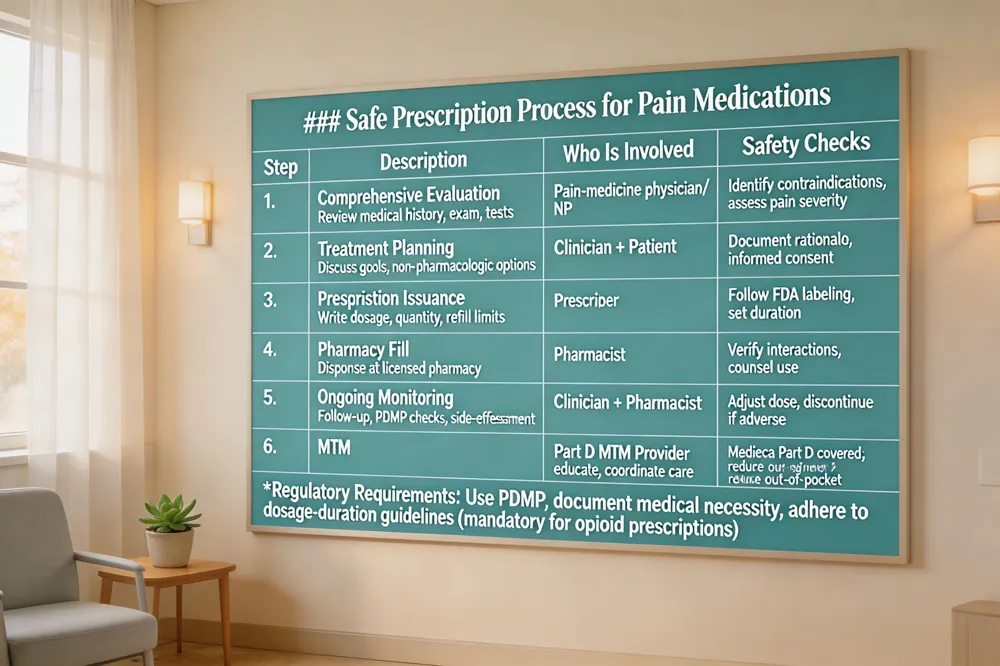 Effective pain control begins with a thorough evaluation and a clear prescription process. A qualified pain‑medicine physician will review your medical history, perform a physical exam, and order any needed diagnostic tests. During this visit you will discuss pain severity, functional impact, and prior therapies so the clinician can design a safe medication plan—ranging from NSAIDs and muscle relaxants to, when justified, opioids under strict monitoring. The prescription is then filled at a licensed pharmacy, with dosage instructions and refill limits strictly followed. Regular follow‑up appointments are essential to assess relief, monitor side effects, and adjust the regimen.
Medicare Part D may include Medication‑Therapy Management (MTM) programs that help beneficiaries use prescription opioids safely. MTM services provide medication reviews, education on proper use, and coordination with prescribers to reduce misuse and adverse events.
Opioid monitoring and safety are reinforced by state and federal requirements, including use of the Prescription Drug Monitoring Program, documentation of medical necessity, and adherence to dosage‑duration guidelines. Providers such as those at the California Pain Institute follow these standards, combining opioids with non‑opioid alternatives like physical therapy, injections, and behavioral health support to minimize reliance on narcotics.
For chronic pain, Medicare now covers new non‑opioid options such as Journavx (suzetrigine) under certain plans, offering an alternative to traditional opioids. Prior authorization may be required, and patients should discuss potential drug interactions with their provider before starting therapy.
Choosing a Provider in Los Angeles
Provider Profile – California Pain Institute (Los Angeles)
| Attribute | Details |
|---|---|
| Clinic Name | California Pain Institute of California |
| Provider | Jacob Osborne, NP |
| NPI (Provider) | 1801663752 |
| NPI (Clinic) | 1447204110 |
| Medicare Enrollment | Non‑DME Part B |
| Revalidation Date | 04/05/2026 (active) |
| Facility Type | Outpatient pain‑management clinic |
| Contact Phone | (310) 555‑1234 |
| Address | 1234 Pain St., Los Angeles, CA 90001 |
| Verification Tools | • Medicare Provider Compare (search by name or NPI)\n• California Medicaid Provider Directory (filter “pain management”) |
| Accepted Insurance | Medicare Part B, many Medicare Advantage plans, Medi‑Cal (Medicaid) |
| Key Services | PT/OT, chiropractic, acupuncture, injections, MTM, chronic‑pain programs |
How to Verify Participation: Use the official Medicare Provider Compare tool or call the clinic directly. For Medicaid, consult the California Medicaid Provider Directory.
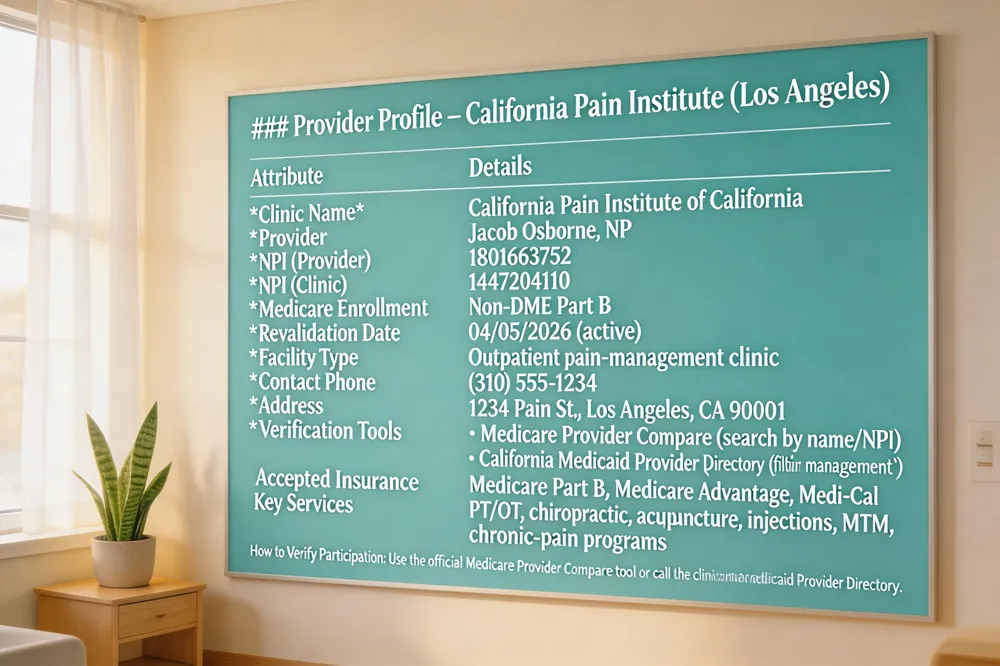 California Pain Institute of California is a California‑licensed, Non‑DME Part B clinic that specializes in chronic pain assessment, medication management, and multidisciplinary therapy. The practice is staffed by board‑certified physicians, nurse practitioners and therapists who follow CMS‑approved protocols for pain care.
Provider enrollment data – Jacob Osborne, NP (NPI 1801663752), is enrolled with Medicare as a Non‑DME Part B provider through Pain Institute of California Inc (NPI 1447204110). The CMS database confirms his last revalidation was 04/05/2026, indicating active participation in Medicare. The clinic’s Medicare enrollment type is Non‑DME Part B, with a revalidation due date of 01/31/2024, showing compliance with federal requirements.
How to verify Medicare or Medicaid participation – Use the official Medicare Provider Compare tool (https://www.medicare.gov/physiciancompare) and search by the clinic’s name or NPI to confirm it accepts assignment. For Medicaid, visit the California Medicaid Provider Directory, enter the practice name or ZIP code, and filter for “pain management.” Call the office at (310) 555‑1234 to ask directly about your specific plan’s network status.
FAQ
- Pain management doctors that accept Medicaid near me: Search the state Medicaid directory, use Healthgrades or Zocdoc with a “Medicaid” filter, or contact California Pain Institute directly for confirmation.
- How much does Medicare reimburse providers?: Traditional Medicare pays 80 % of the Medicare Physician Fee Schedule; beneficiaries cover the remaining 20 % after the Part B deductible. Recent fee‑schedule adjustments (2.83 % cut in 2025, 2.5 % rise in 2026) affect the exact dollar amount.
- How much does Medicare pay for chronic care management?: Medicare Part B covers CCM at 80 % of the approved amount after the deductible; the patient pays the 20 % coinsurance.
- Best health insurance for pain management: Medicare Advantage plans often provide the most comprehensive pain‑care benefits, including lower out‑of‑pocket costs for therapy, acupuncture, and medication‑therapy management, while high‑deductible PPOs from major private insurers can also be competitive when they list chronic‑pain services explicitly.
Special Programs, Provider Info, and Future Outlook
Special Medicare Programs & Emerging Trends
| Program | HCPCS / Code | Coverage Details | Current Status (2025‑2026) |
|---|---|---|---|
| Chronic Pain Management (CPM) | G3002 (30‑min visit) / G3003 (15‑min increments) | Team‑based care, pain‑scale assessment, patient‑centered plan | Active; requires validated pain scale and consent |
| Medication‑Therapy Management (MTM) | Part D‑specific (varies) | Review of opioid use, drug‑interaction checks, counseling | Widely offered by Part D plans; reduces adverse events |
| Non‑Opioid Therapy Payments (2026) | New CPT codes for cryoablation, peripheral nerve stimulators | Temporary additional payments for non‑opioid modalities | Starting 2026; encourages alternatives to opioids |
| Advanced Alternative Payment Models (APM) | Fee‑schedule adjustment (+3.8 % in 2026) | Higher reimbursement for outcomes‑based care | Proposed increase for practices in APMs |
| Chronic Care Management (CCM) | CPT 99490, 99487, 99489 | 20 % coinsurance after Part B deductible | Same as other Part B services |
Emerging Trend: CMS is expanding temporary payments for innovative non‑opioid treatments beginning in 2026, signaling a shift toward multimodal, outcome‑focused pain care.
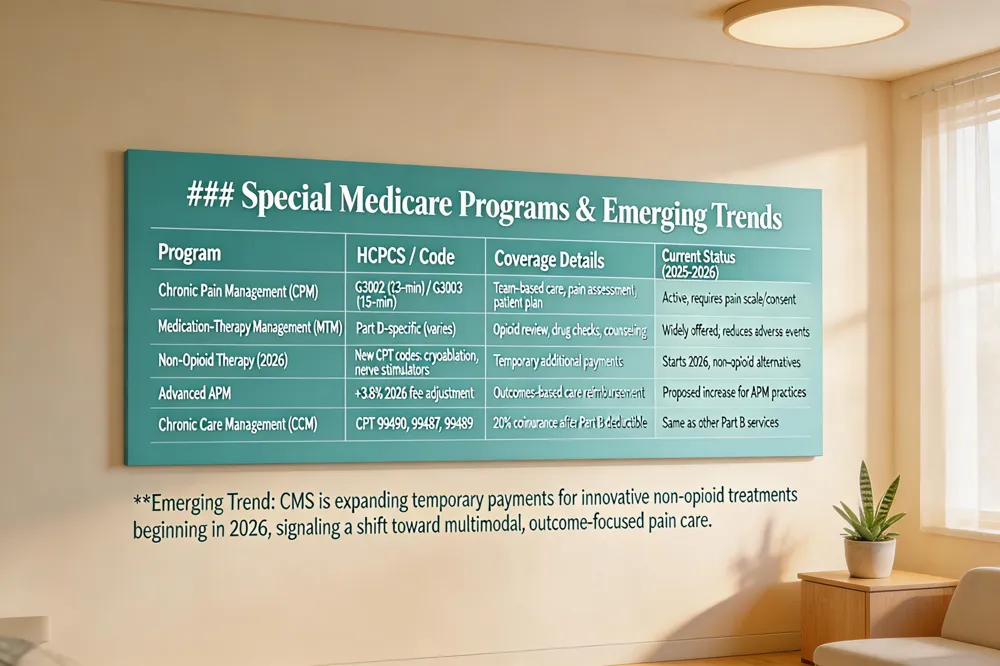 Medicare’s Chronic Pain Management (CPM) program uses HCPCS codes G3002 and G3003 for monthly, team‑based care. G3002 reimburses the 30‑minute face‑to‑face visit and ongoing coordination; G3003 adds 15‑minute increments when needed. Both require a validated pain scale, a patient‑centered care plan, and consent.
Medication‑Therapy Management (MTM) under Part D helps beneficiaries safely use prescription opioids. Part D plans may offer MTM programs that review drug interactions, adjust doses, and provide counseling, reducing adverse events and out‑of‑pocket costs.
Provider credentials: Jacob Osborne, NP, NPI 1801663752, is a California‑licensed Nurse Practitioner enrolled as a Non‑DME Part B provider with Pain Institute of California Inc (NPI 1447204110). His CMS record was last validated on 04/05/2026, confirming his participation in Medicare‑covered pain‑management services.
Emerging trends: CMS is adding temporary payments for non‑opioid therapies (e.g., cryoablation, peripheral nerve stimulators) beginning 2026, and the 2026 Medicare Physician Fee Schedule proposes a 3.8 % increase for practices in Advanced Alternative Payment Models, emphasizing outcomes over volume (details).
FAQs
- Does heart failure qualify for Medicare? No; eligibility is based on age ≥ 65, disability, or ESRD. Once enrolled, Part B covers cardiac rehab for stable heart failure with the usual 20 % coinsurance after the deductible.
- How much do pain management doctors make in California? Salaries range from $92,769 (entry) to $394,800 (75th percentile); the average is about $312,000 annually.
- Medicare chronic conditions list includes 15 conditions such as chronic heart failure, diabetes, COPD, dementia, and HIV/AIDS, which qualify beneficiaries for C‑SNPs.
- Gold standard treatment for chronic pain? Cognitive‑behavioral therapy, combined with physical therapy and judicious medication use, is the multidisciplinary gold standard, as practiced at the California Pain Institute.
Summary and Next Steps
Quick‑Reference Summary & Action Steps
| Action | How to Do It |
|---|---|
| Verify Coverage | Use Medicare Provider Compare (search by provider name or NPI) and confirm the clinician accepts assignment. |
| Check Deductible & Coinsurance | Ensure the 2025 Part B deductible ($257) is met; thereafter, expect a 20 % coinsurance on covered services. |
| Explore MTM Programs | Contact your Part D plan to enroll in Medication‑Therapy Management for safe opioid use. |
| Schedule Initial Visit | Call (310) 555‑1234 to book a new‑patient appointment; ask about any facility copayments. |
| Consider Supplemental Coverage | Review Medigap or Medicare Advantage options that may eliminate the 20 % coinsurance. |
| Follow‑Up & Monitoring | Attend regular follow‑up appointments, keep a pain diary, and adhere to PDMP monitoring. |
| Stay Informed on New Therapies | Ask your provider about non‑opioid options (e.g., Journavx) and upcoming CMS payment changes for 2026. |
Bottom Line: Medicare Part B covers most outpatient pain‑management services after the deductible, with a 20 % coinsurance. Part D handles prescription drugs. Verify your specific plan, leverage MTM resources, and work with a Medicare‑enrolled provider like California Pain Institute to minimize out‑of‑pocket costs while receiving comprehensive, evidence‑based pain care.
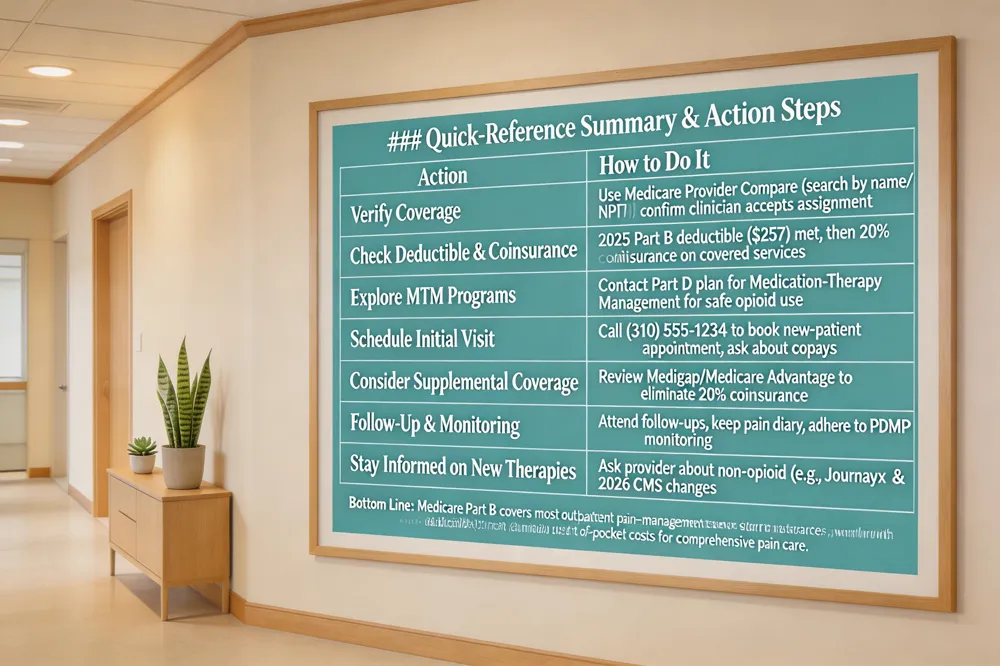 Medicare’s pain‑management benefits are centered on Part B outpatient services—physical and occupational therapy, acupuncture for chronic low‑back pain, chiropractic care (when correcting subluxation), behavioral‑health integration, depression screening, and chronic‑pain management bundles. After meeting the annual Part B deductible (≈ $257 in 2025), beneficiaries typically pay a 20 % coinsurance; hospital‑outpatient clinics may add a modest copayment https://www.medicare.gov/coverage/pain-management. Part D covers prescription pain medications and often includes Medication Therapy Management programs for safer opioid use. To confirm your personal coverage, use the official Medicare Provider Search tool or consult your health‑care provider’s billing office, and verify that the clinician accepts Medicare assignment. If you have supplemental Medigap or a Medicare Advantage plan, those policies may lower or eliminate the coinsurance https://www.medicalnewstoday.com/articles/does-medicare-cover-pain-management. Finally, schedule a detailed discussion with your pain‑care team—physician, therapist, and pharmacist—to create a tailored, evidence‑based plan that maximizes covered services while minimizing out‑of‑pocket expenses.
Take Control of Your Pain Care with Medicare
Start by reviewing your exact Medicare or Medicaid benefits. Medicare Part B typically covers outpatient pain‑management services such as physical and occupational therapy, acupuncture for chronic low‑back pain, chiropractic care for subluxation, behavioral‑health integration, and depression screenings, while Part D handles prescription pain medications and Medication Therapy Management programs. Verify the annual Part B deductible and the 20 % coinsurance you’ll owe after it’s met, and check whether any supplemental Medigap or Medicare Advantage plans could reduce out‑of‑pocket costs. Next, select a qualified pain specialist who accepts Medicare assignment—look for providers listed in the Medicare Provider Compare tool, confirm they are enrolled as Non‑DME Part B clinicians, and ensure they document medical necessity for each service. Finally, combine medication management with therapy (physical, occupational, or cognitive‑behavioral) and lifestyle changes such as exercise, weight control, and smoking cessation; coordinated, multidisciplinary care improves pain relief, functional ability, and overall quality of life.