A New Era for Chronic Pain Management
Chronic pain is now understood as a biopsychosocial condition, where physical injury, emotional distress and social factors intertwine. Traditional single‑discipline models—often limited to medication or isolated therapy—frequently fail to address this complexity, leading to persistent pain, opioid dependence, and high health‑care use. In response, the United States has embraced team‑based, interdisciplinary programs that unite physicians, physical therapists, psychologists, nurses, pharmacists and occupational therapists. These coordinated teams share real‑time communication, set unified goals and deliver multimodal care, resulting in greater pain relief, improved function and reduced opioid use. The California Pain Institute exemplifies this shift, dedicating its mission to integrated, evidence‑based treatment that empowers patients and lowers long‑term costs for individuals nationwide and societal health outcomes.
What Does a Chronic Pain Team Do?
| Function | Team Members Involved | Example Activities |
|---|---|---|
| Comprehensive assessment | Pain physician, nurse specialist, PT, psychologist, pharmacist, OT, social worker | Review pain history, physical exam, functional impact, biopsychosocial screening |
| Integrated treatment planning | All core members (physician, nurse, PT, psychologist, pharmacist) | Joint case conference to create a multimodal plan |
| Therapeutic delivery | Physician (meds & interventions), PT/OT (rehab), psychologist (CBT), pharmacist (medication safety) | Medication management, nerve blocks, graded exercise, CBT, biofeedback |
| Care coordination & follow‑up | Nurse coordinator, case manager | Schedule visits, monitor side‑effects, connect to community resources |
| Patient education & empowerment | Nurse, psychologist, PT | Teach self‑management, coping strategies, activity pacing |
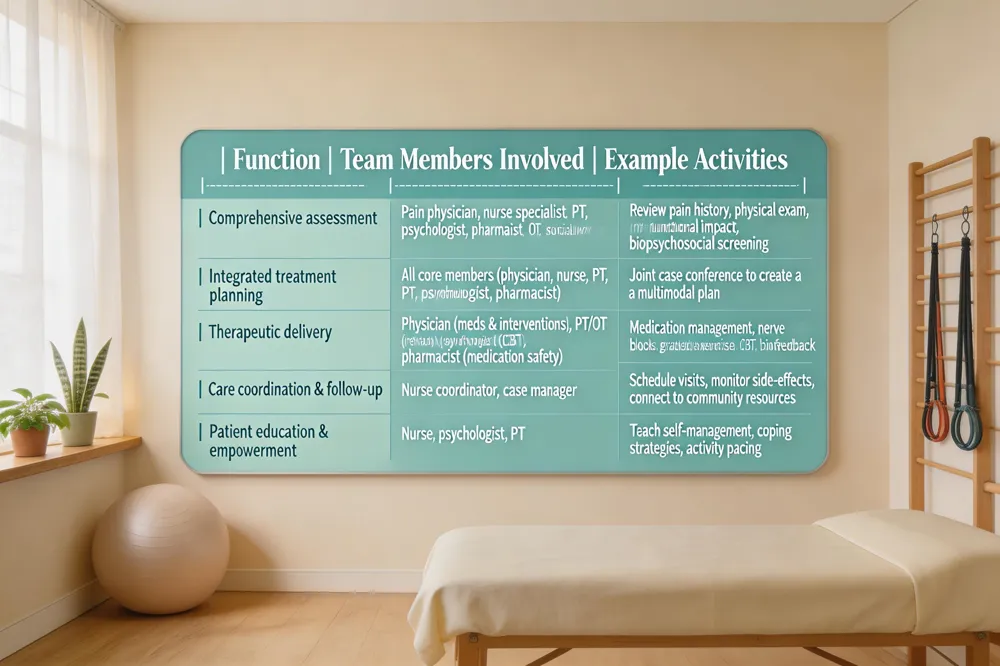 A chronic pain team Conduct a comprehensive assessment of each patient’s pain history, physical findings, and functional impact on daily life to establish a clear diagnosis. The interdisciplinary group—typically comprising pain physicians, nurse specialists, physical therapists, psychologists, pharmacists, and, when needed, occupational therapists, social workers, or surgical specialists—holds joint case conferences to develop an integrated treatment plan. This plan combines a range of therapeutic modalities: medication management (including opioid stewardship), interventional procedures such as nerve blocks or spinal cord stimulation, graded physical‑rehabilitation programs, cognitive‑behavioral therapy, relaxation/biofeedback training, and vocational or ergonomic counseling. The team coordinates referrals and connects patients with community resources, ensuring seamless continuity of care. By aligning goals across disciplines, the team reduces duplication of services, enhances patient education, and empowers self‑management, ultimately improving pain control, functional ability, and quality of life.
Benefits of Interdisciplinary Teams in Healthcare
| Benefit | How Achieved | Impact Metric |
|---|---|---|
| Reduced duplication of services | Shared assessments & real‑time EHR | 20‑30% fewer repeat imaging/tests |
| Lower medication errors | Pharmacist verification & opioid stewardship | 40% drop in adverse drug events |
| Higher patient satisfaction | Coordinated, timely care | 92‑95% satisfaction rates |
| Decreased healthcare utilization | Integrated care pathways | Fewer hospitalizations & surgeries |
| Cost savings | Elimination of redundant procedures | $260 M saved annually for 17,600 patients |
| Improved functional outcomes | Combined physical & behavioral therapy | 20% average pain reduction, 67% return‑to‑work |
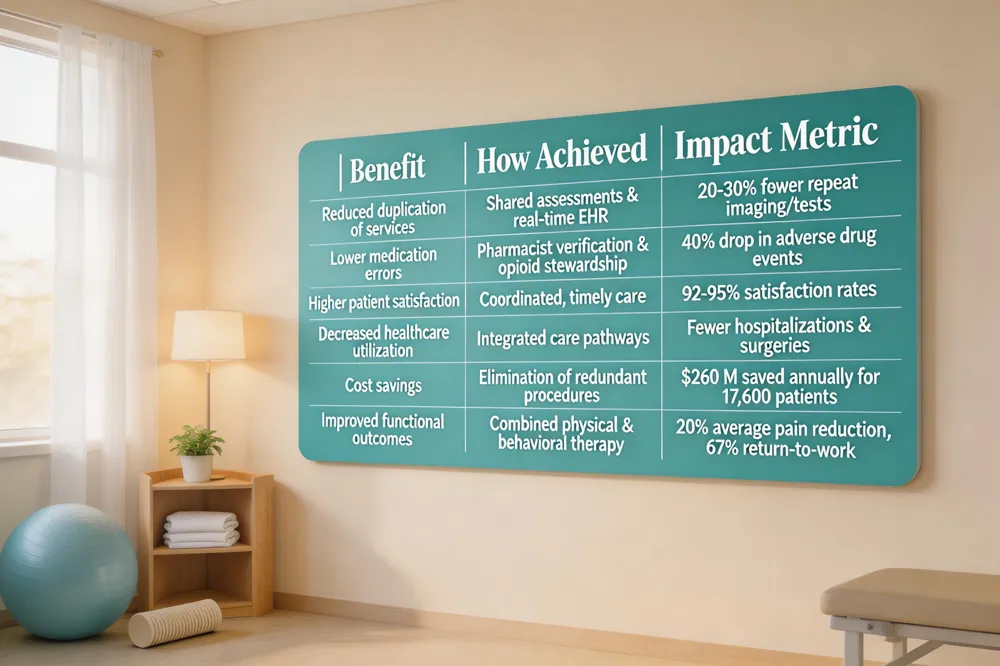 Interdisciplinary teams bring together physicians, physical therapists, psychologists, nurses, pharmacists, and other specialists to create a holistic, patient‑centered plan that addresses the biological, psychological, and social dimensions of chronic pain. By sharing assessments and treatment goals in real time, teams avoid redundant imaging, laboratory tests, and duplicate procedures, which cuts unnecessary costs and reduces exposure to potential complications. Integrated communication also minimizes medication errors—pharmacists can verify prescriptions while clinicians monitor for drug interactions and opioid stewardship—thereby enhancing patient safety. Patients report higher satisfaction because they receive coordinated, timely care and feel heard by a unified care group; studies show satisfaction rates of 92‑95 % in interdisciplinary settings. Providers benefit from shared responsibility, regular case conferences, and peer support, which improve job satisfaction and lower burnout risk. The combined effect is a measurable reduction in health‑care utilization, fewer hospitalizations and surgeries, and overall cost savings that make interdisciplinary care both clinically effective and economically advantageous for communities such as Los Angeles.
Interdisciplinary Team Communication
| Communication Tool/Practice | Description | Outcome |
|---|---|---|
| Structured case conferences (weekly/bi‑weekly) | All providers discuss goals, progress, side‑effects | Rapid plan adjustments, reduced delays |
| Shared electronic health record (EHR) | Real‑time access to notes, orders, outcomes | Fewer information gaps, consistent documentation |
| Defined roles & responsibilities | Clear scope for each discipline | Prevents overlap, streamlines workflow |
| Psychologically safe environment | Encourages open discussion of concerns | Higher team morale, fewer errors |
| SBAR (Situation‑Background‑Assessment‑Recommendation) | Concise hand‑off format used by nurses | Clearer communication, quicker decision‑making |
| Bedside huddles & interdisciplinary rounds | Short, frequent team check‑ins | Enhanced patient safety, better satisfaction |
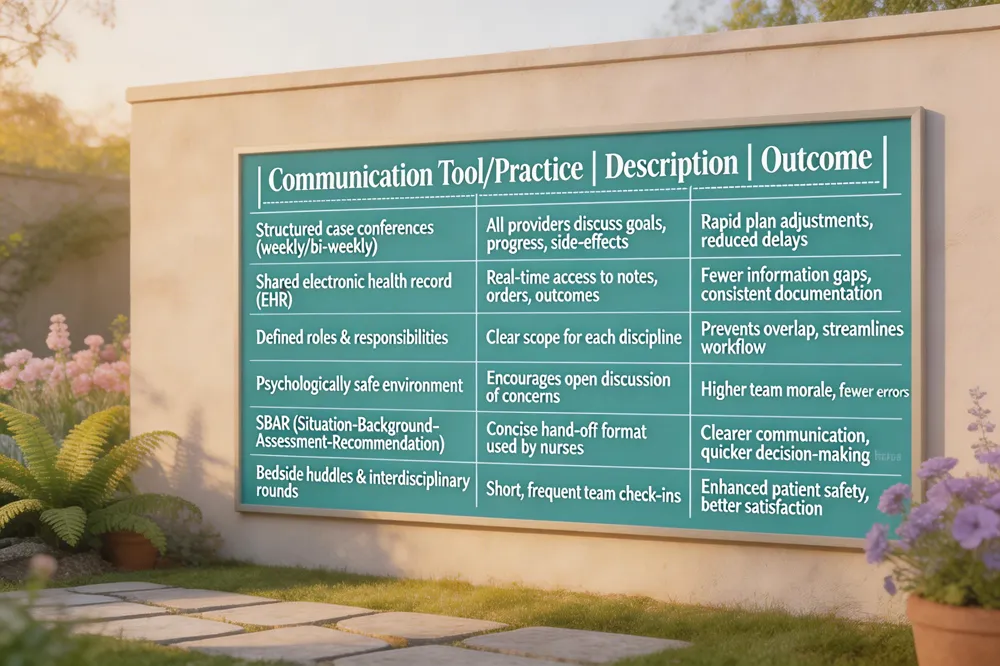 Effective interdisciplinary team communication is achieved through structured, regular case conferences where all providers discuss patient goals and progress. A shared electronic health record ensures that every clinician has real‑time access to assessments, treatment plans, and outcomes, reducing information gaps. Clearly defined roles and responsibilities prevent overlap and clarify who leads each aspect of care. Fostering a psychologically safe environment encourages team members to voice concerns, ask questions, and suggest adjustments without fear of retribution. Ongoing communication training and feedback loops help maintain these practices, ultimately improving patient safety and satisfaction. In practice, weekly or bi‑weekly multidisciplinary meetings enable rapid adjustment of therapy plans based on patient‑reported pain scores, functional milestones, and medication side‑effects. When each discipline—physician, physical therapist, psychologist, pharmacist, nurse, or social worker—knows its specific contribution and the shared documentation platform, duplication of services declines and care becomes more efficient. This coordinated approach not only enhances clinical outcomes such as reduced opioid use and higher return‑to‑work rates but also boosts patient confidence, as they perceive a united, transparent care team guiding their recovery.
Interdisciplinary Team Roles and Responsibilities
| Role | Primary Responsibilities | Key Contributions |
|---|---|---|
| Pain Physician | Diagnosis, medication prescribing, interventional procedures | Clinical leadership, treatment selection |
| Nurse (Care Coordinator) | Scheduling, safety monitoring, patient education, liaison | Continuity of care, patient empowerment |
| Physical Therapist | Graded exercise, functional rehab, mobility training | Restores strength, reduces disability |
| Psychologist / Behavioral Health Specialist | CBT, mindfulness, coping‑skill workshops | Addresses anxiety, depression, catastrophizing |
| Pharmacist | Medication optimization, interaction checks, opioid stewardship | Improves safety, reduces adverse events |
| Occupational Therapist | Ergonomic counseling, activity pacing | Supports return‑to‑work and daily functioning |
| Social Worker / Case Manager | Insurance navigation, community resources | Reduces psychosocial barriers |
| Dietitian (when present) | Nutrition counseling | Enhances overall health and recovery |
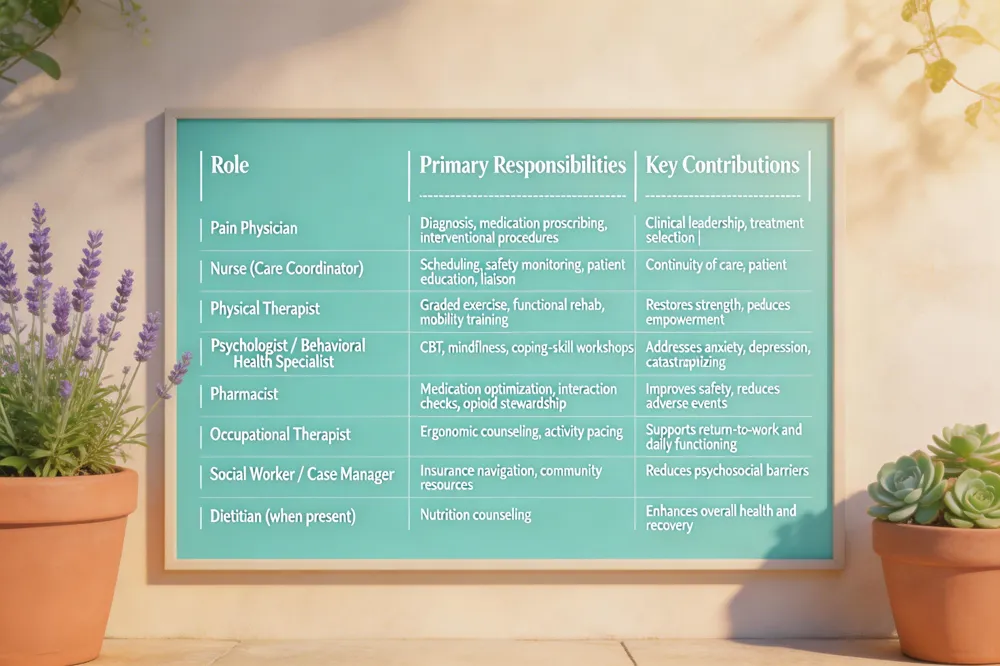 Interdisciplinary pain programs rely on a clearly defined set of roles that together create a seamless, patient‑centered experience. The pain physician provides clinical leadership, conducting thorough biopsychosocial assessments, confirming diagnoses, prescribing medication, and selecting interventional procedures when needed. Nurses act as care coordinators and educators; they schedule follow‑ups, monitor safety, teach self‑management techniques, and serve as the primary point of contact for patients and families. Physical therapists design and supervise graded exercise and functional rehabilitation plans that restore mobility, increase strength, and reduce pain‑related disability. Psychologists or behavioral‑health specialists deliver cognitive‑behavioral therapy, mindfulness training, and coping‑skill workshops that address anxiety, depression, and catastrophizing, thereby enhancing adherence to the overall regimen. Additional specialists—pharmacists, dietitians, case managers, and sometimes spiritual counselors—support medication optimization, nutrition counseling, insurance navigation, and holistic well‑being. All team members meet regularly for case conferences, share progress notes through a shared electronic health record, and adjust treatment goals collaboratively. This integrated approach ensures that each facet of chronic pain—biological, psychological, and social—is treated in concert, leading to better functional outcomes, reduced opioid reliance, and higher patient satisfaction.
Interdisciplinary Collaboration: The Nurse’s Role in Team‑Based Healthcare
| Nurse Activity | Interaction With | Effect |
|---|---|---|
| Translate physician orders into care plans | All disciplines (physician, PT, psychologist, pharmacist) | Ensures consistent implementation |
| Use SBAR for hand‑offs | Physicians, therapists, pharmacists | Minimizes misunderstandings |
| Real‑time monitoring of meds & functional progress | Pharmacist, physician, PT | Prompt adjustment of therapies |
| Provide patient/family education | Psychologist, PT | Improves self‑management and adherence |
| Initiate bedside huddles & interdisciplinary rounds | Entire team | Fosters collaboration, early issue detection |
| Coordinate referrals & community resources | Social worker, case manager | Seamless continuity of care |
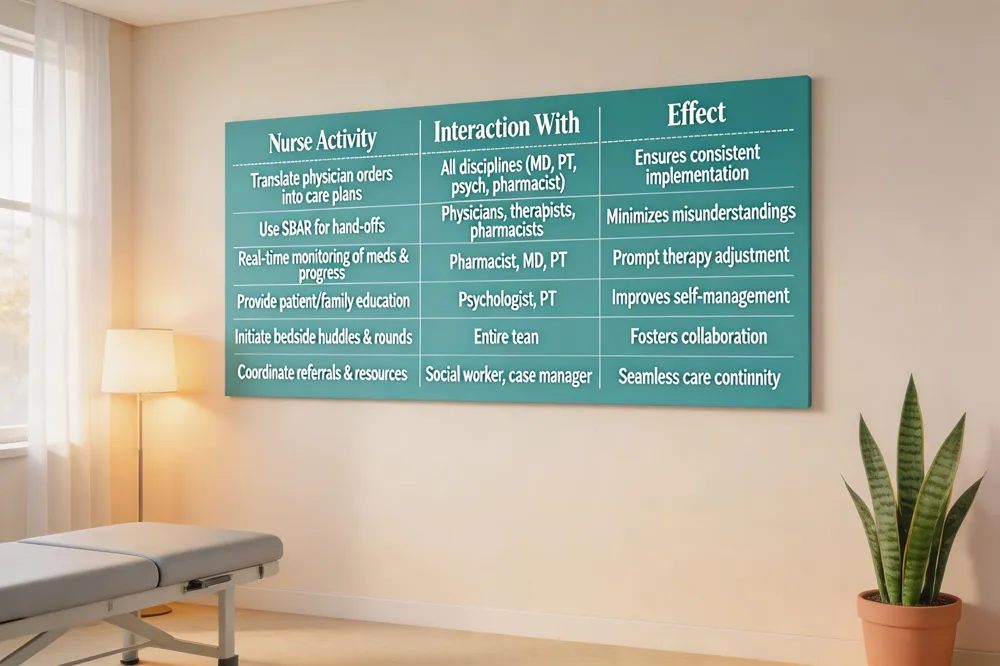 Nurses are the connective tissue that holds interdisciplinary chronic‑management teams together. They translate physician orders into clear, actionable care plans and serve as the primary liaison among physical therapists, psychologists, pharmacists, occupational therapists, and social workers. Using structured communication tools such as SBAR (Situation, Background, Assessment, Recommendation), nurses convey critical information quickly and accurately, minimizing misunderstandings and fostering mutual trust. Their real‑time monitoring of medication side‑effects, functional progress, and psychosocial cues allows the team to adjust interventions promptly, keeping treatment plans responsive to each patient’s evolving needs. Nurses also provide comprehensive patient and family education and teach self‑management strategies such as medication safety and coping techniques that empower patients to engage actively in their recovery. Regular bedside huddles and interdisciplinary rounds—often initiated or coordinated by nurses—create a collaborative environment where every discipline contributes to a unified, patient‑centered approach, ultimately improving outcomes, satisfaction, and safety.
The Broader Picture: Multidisciplinary Pain Management in Practice
| Component | Description | Evidence/Metric |
|---|---|---|
| Definition of multidisciplinary team | Physicians, nurses, PT/OT, psychologists, pharmacists, dietitians, social workers | Core group provides comprehensive care |
| Local clinic example – California Pain Institute (CPI) | One‑site team offering med mgmt, nerve blocks, PT, CBT, tele‑health | Streamlined scheduling, high patient satisfaction |
| 4 P’s framework | Pain, Purpose, Pacing, Positivity guide assessment & treatment | Improves coping, functional outcomes |
| Cost‑effectiveness data | 20% pain reduction, opioid use ↓ from 65% to 20%, RTW ↑ to 67% | $260 M saved annually, $2.5 B lifetime disability savings |
| Residential program overview | In‑patient intensive medication titration, daily PT, behavioral counseling | Sustained outpatient gains, reduced medication reliance |
| Common FAQs | Definitions, local clinics, opioid prescribing, residential programs, 4 P’s | Provides quick reference for patients & providers |
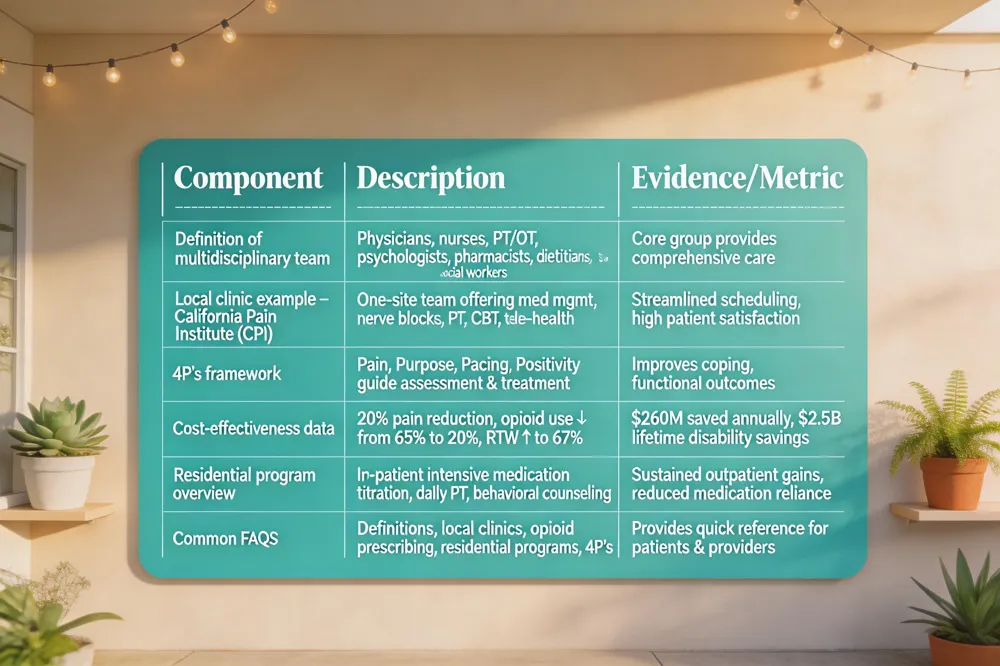 Definition of a multidisciplinary pain team
A multidisciplinary pain team assembles physicians, nurses, physical and occupational therapists, psychologists, pharmacists and often dietitians and social workers. The core group includes a pain‑medicine physician (often an anesthesiologist), a clinical psychologist, a physical therapist, and a dedicated pain nurse. Each professional conducts a biopsychosocial assessment, contributes expertise to a coordinated treatment plan, and educates patients on pain mechanisms and self‑management. Regular interdisciplinary meetings ensure that medication, interventional procedures, rehabilitation, and behavioral therapies are integrated and adjusted based on progress.
Local clinic example – California Pain Institute (CPI)
CPI in Los Angeles exemplifies this model. Board‑certified pain physicians, physical therapists, psychologists and nurse specialists evaluate patients together, then craft personalized plans that may include medication management, nerve blocks, graded exercise, and CBT. All services are provided in one facility, eliminating fragmented appointments. CPI accepts most major insurances and offers both in‑person and telehealth visits for convenience.
Convenient access and insurance coverage
Because CPI operates under a single‑site interdisciplinary framework, patients experience streamlined scheduling and reduced duplication of tests. Insurance contracts typically cover the core services—physician visits, PT, and psychotherapy—when medically justified, and many plans now reimburse for tele‑pain‑management sessions.
Residential (in‑patient) program overview
CPI’s residential program places patients on‑site for several weeks. A full team—including physicians, PT/OT, psychologists, and nurses—delivers intensive medication titration (including safe opioid tapering), daily physical therapy, behavioral counseling, and pain‑neuroscience education. Participants leave with an outpatient plan designed to sustain functional gains and reduce medication reliance.
The 4 P’s of chronic pain framework
The 4 P’s—Pain, Purpose, Pacing, Positivity—guide clinicians and patients. Pain identifies intensity and location; Purpose explores goals and motivations; Pacing balances activity with rest to avoid overload; Positivity fosters a hopeful outlook that improves coping.
Cost‑effectiveness and return‑to‑work data
Meta‑analyses show average 20% pain reduction (range 0‑60%). Opioid use drops from 65 % to 20 % after interdisciplinary care. Return‑to‑work rates rise to 67 % vs 24 % versus conventional treatment, while healthcare utilization (hospitalizations, surgeries) falls dramatically. $260 million saved in one‑year medical costs for 17,600 patients and $2.5 billion in lifetime disability savings make interdisciplinary programs roughly nine times more cost‑effective than conservative care.
Answers to common questions
- The multidisciplinary team in pain management: See definition above.
- Multidisciplinary pain clinic near me: California Pain Institute, Los Angeles.
- Pain management doctors near me that prescribe narcotics: CPI’s board‑certified physicians follow strict opioid‑prescribing guidelines, pairing narcotics with multimodal therapies.
- Residential pain management programs: CPI’s inpatient program delivers coordinated, intensive care.
- What are the 4 P’s of chronic pain?: Pain, Purpose, Pacing, Positivity.
- What is an interdisciplinary pain management program?: Integrated, communication‑rich care by multiple disciplines with shared goals, unlike fragmented single‑discipline treatment.
Putting It All Together – A Path Forward
Team‑based, interdisciplinary pain management consistently outperforms single‑discipline care. Meta‑analyses and large cohort studies show average pain reductions of 20‑30%, opioid use drops from 65% to 20‑25% of patients, and return‑to‑work rates rise from 24% to roughly 67%. These clinical gains translate into major economic benefits: one‑year post‑treatment medical costs fall by $260 million for 17,600 patients, surgical expenses by $63 million, and lifetime disability savings approach $2.5 billion over 20 years. For Los Angeles residents, choosing an interdisciplinary program—such as the California Pain Institute’s team of physicians, therapists, psychologists, and pharmacists—offers better pain control, functional recovery, and lower out‑of‑pocket costs. Take the first step today by consulting a local multidisciplinary pain clinic.