

Why Specialist Care Matters
Chronic pain affects roughly 20% of U.S. adults—over 116 million people—making it a leading cause of disability and missed work days. Early referral to a pain specialist, ideally within three to six months of symptom onset, dramatically reduces the risk of pain chronification, opioid dependence, and long‑term disability. Specialists are board‑certified physicians who use advanced imaging, nerve‑conduction studies, and quantitative sensory testing to pinpoint the pain source, allowing targeted interventions such as nerve blocks, spinal cord stimulation, or regenerative therapies. Multidisciplinary teams—physicians, physical therapists, psychologists, occupational therapists, and nurses—coordinate medication optimization, graded activity, cognitive‑behavioural therapy, and lifestyle coaching. Robust evidence shows that such integrated programs achieve 30‑40% greater reductions in pain intensity, 20‑30% improvements in functional ability, and lower opioid use compared with primary‑care‑only treatment. Patients who receive specialist‑led, biopsychosocial care report higher satisfaction, faster return‑to‑work rates, and sustained quality‑of‑life gains lasting up to three years.
The Core Benefits of Specialist‑Led Pain Management
Core Benefits Summary
| Benefit | Description | Evidence of Improvement |
|---|---|---|
| Pain Reduction | Multimodal therapy (pharma, physical, psychological) targets pain pathways | 30‑40 % greater reduction vs. standard care |
| Functional Capacity | Restores mobility, work ability, daily activities | 20‑30 % improvement in functional scores |
| Opioid Use | Careful opioid monitoring & alternatives lower dependence | Reduced long‑term opioid reliance |
| Cost Savings | Early specialist referral prevents complications & disability | Lower overall healthcare expenditures |
| Quality of Life | Addresses sleep, mood, fatigue through biopsychosocial model | Consistent improvements in patient‑reported outcomes |
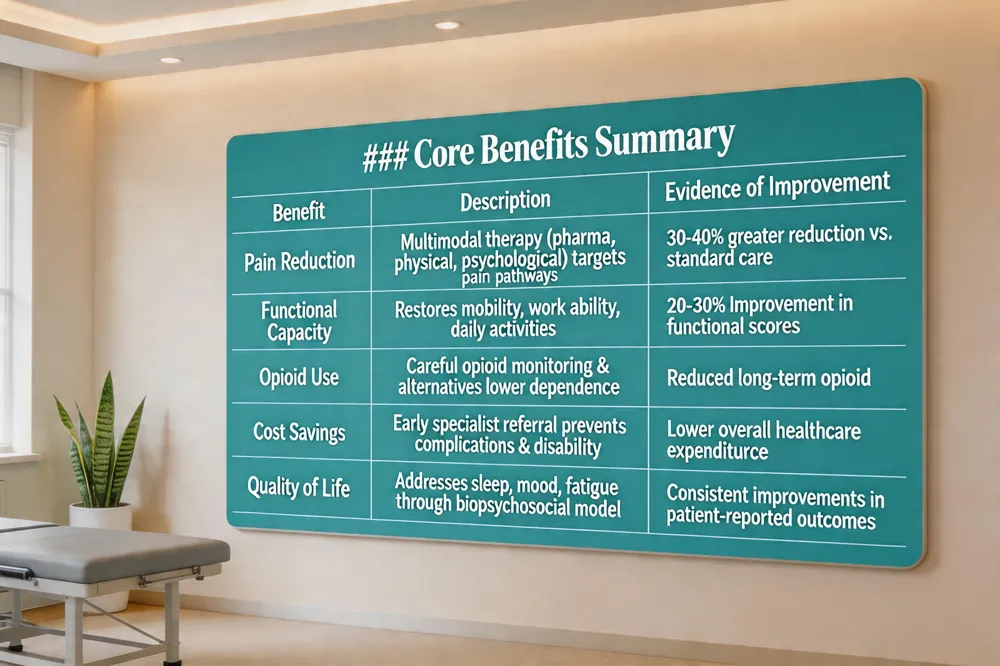 Chronic pain dramatically lowers quality of life, restricting daily activities, mobility, work, and social participation while increasing fatigue, sleep disturbances, anxiety, and depression. Effective pain management restores function, reduces stress, and prevents costly complications such as opioid dependence and prolonged disability. A person qualifies for pain‑management care when pain persists beyond the usual healing period (typically >3 months) or when it interferes with work, sleep, or overall well‑being, regardless of age or diagnosis.
Specialist‑led programs address pain through three complementary approaches: pharmacologic therapy (NSAIDs, anticonvulsants, carefully monitored opioids), physical interventions (graded exercise, physical therapy, interventional procedures like nerve blocks or spinal cord stimulation), and psychological strategies (cognitive‑behavioral therapy, mindfulness, ACT). This multimodal model aligns with the biopsychosocial framework and has been shown to achieve 30‑40 % greater pain reduction and 20‑30 % improvements in functional capacity.
Chronic pain is classified into four types—neuropathic, musculoskeletal, mechanical, and inflammatory—guiding targeted, evidence‑based treatments. Early referral to a board‑certified pain specialist ensures comprehensive assessment, accurate diagnosis, and coordinated, interdisciplinary care that improves quality of life and reduces long‑term healthcare costs.
Physiotherapy and Education – Pillars of Recovery
Physiotherapy & Education Highlights
| Intervention | Primary Goal | Key Points |
|---|---|---|
| Graded Exercise | Break “boom‑bust” cycle, improve strength | Starts low, progresses based on tolerance |
| Manual Therapy | Correct biomechanical imbalances | Joint mobilization, soft‑tissue work |
| Pain‑Science Education | Demystify central sensitization, lower fear‑avoidance | Handouts, PDFs, verbal teaching |
| Mindfulness/ACT | Reduce catastrophizing, improve coping | Short‑term sessions, home practice |
| Cultural Tailoring | Align communication with patient beliefs | Use interpreters, culturally relevant metaphors |
Takeaway: Combining hands‑on rehab with clear education empowers patients to self‑manage pain and sustain progress.
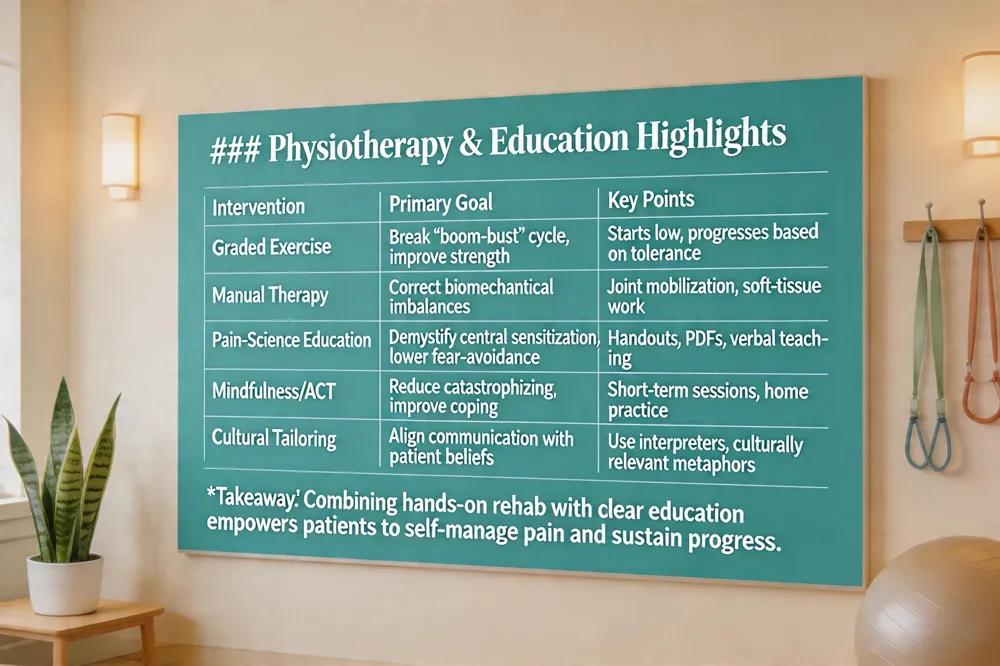 Physiotherapy is a cornerstone of chronic‑pain management because it restores movement, strength, and function while re‑training the nervous system to down‑regulate pain signals. Targeted exercise, manual therapy, and graded activity break the "boom‑bust cycle", reduce inflammation, and correct biomechanical imbalances that perpetuate pain. When combined with pain‑science education, physiotherapists demystify central sensitization, lower fear‑avoidance, and empower patients to self‑manage their condition.
Effective health education complements this work. Clear explanations of acute versus chronic pain, medication risks, and non‑pharmacologic options (e.g., mindfulness, acupuncture) give patients the tools to monitor symptoms, adhere to medication regimens, and adopt lifestyle changes such as regular exercise, sleep hygiene, and stress reduction. Written handouts, PDFs, and scheduled follow‑ups reinforce learning and enable timely plan adjustments.
Cultural beliefs shape how pain is perceived and reported. Some cultures encourage open expression and alternative therapies, while others may suppress pain or defer to physician authority. Understanding these nuances allows clinicians to tailor communication, respect patient preferences, and choose culturally appropriate interventions, ultimately improving engagement and outcomes.
Los Angeles’ Leading Pain‑Care Centers
LA Pain‑Care Centers Overview
| Center | Locations (selected) | Core Services |
|---|---|---|
| UCLA Health | Downtown LA, Encino, North Hollywood, Santa Monica, Torrance | Medication management, PT, acupuncture, epidural/facet injections, spinal cord stimulation, mental‑health support |
| Cedars‑Sinai | 444 S. San Vicente Blvd. (LA) | Outpatient evaluation, interventional procedures, behavioral therapy, multidisciplinary team |
| California Pain Institute | Van Nuys, Torrance, other LA sites | Medication optimization, radiofrequency ablation, PT, acupuncture, chiropractic, regenerative therapies |
| LA Pain & Wellness Institute | Various LA neighborhoods | Physician‑directed pain care, functional restoration, workers’‑compensation services |
Note: All centers employ board‑certified pain specialists and offer comprehensive diagnostic work‑ups (MRI, nerve‑conduction studies, quantitative sensory testing).
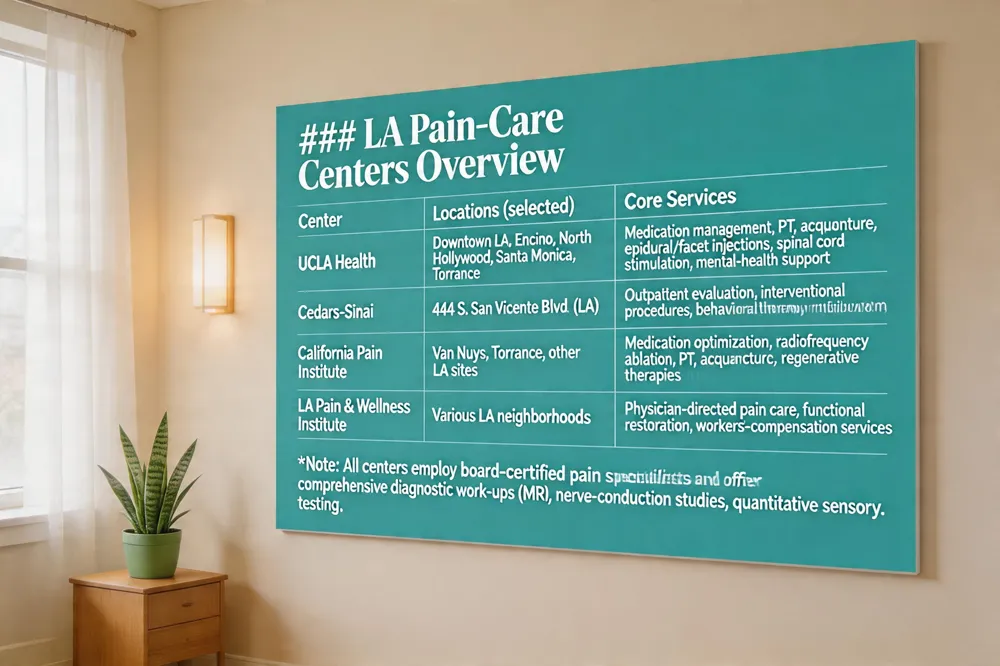 The Los Angeles metro area hosts a network of specialist pain‑management clinics that combine board‑certified physicians, psychologists, physical and occupational therapists, and nurses to deliver biopsychosocial care. Major centers such as UCLA Health, Cedars‑Sinai, and the California Pain Institute offer comprehensive diagnostic work‑ups—including MRI, nerve‑conduction studies, and quantitative sensory testing—to pinpoint nociceptive, neuropathic, or nociplastic pain mechanisms.
Pain management UCLA – UCLA Health’s Comprehensive Pain Center provides personalized plans that blend medication management, physical therapy, acupuncture, epidural and facet‑injection procedures, radiofrequency ablation, and spinal cord stimulation, while integrating mental‑health support for holistic recovery.
UCLA pain management locations – Services are available at downtown LA (700 W. 7th St., Suite S270‑D), Encino (15503 Ventura Blvd., Suites 150‑240), North Hollywood (4343 Lankershim Ave., Suite 200), Santa Monica (1245 16th St., Suite 225), and Torrance (3500 Lomita Blvd., Suite M100).
Pain Management Van Nuys – The California Pain Institute in Van Nuys delivers multimodal treatment including medication optimization, interventional injections, radiofrequency ablation, physical therapy, acupuncture, and chiropractic care, all coordinated by board‑certified pain physicians.
Pain management Torrance, CA – At the Torrance campus (23550 Hawthorne Blvd., Suite 120), specialists provide epidural steroid injections, nerve blocks, intrathecal pumps, regenerative therapies, and a multidisciplinary rehabilitation program to restore function and reduce opioid reliance.
Pain and Wellness Center – These centers integrate advanced interventional techniques with lifestyle coaching, nutrition counseling, and stress‑reduction strategies to empower patients toward long‑term, opioid‑free living.
Pain and Wellness Center near me – The LA Pain & Wellness Institute, led by Dr. Jorge Minor, offers physician‑directed pain management, functional restoration, and workers’‑compensation services, available Monday‑Friday 9 am‑5 pm.
Pain management Cedars‑Sinai – Cedars‑Sinai’s Pain Center provides outpatient evaluation, medication management, interventional procedures, and behavioral therapy, staffed by Dr. Mary A. Vijjeswarapu, Dr. Andrew M. Blumenfeld, and a multidisciplinary team at 444 S. San Vicente Blvd.
Cedars‑Sinai Pain Management Doctors – The team includes Dr. Mary A. Vijjeswarapu, Dr. Karl D. Wittnebel, Dr. Andrew M. Blumenfeld, and director Dr. Laura G. Audell, offering comprehensive, evidence‑based care.
Best pain management doctors in Los Angeles – Notable specialists include Dr. Hayley Osen (UCLA), Dr. Najmeh P. Sadoughi, Dr. Jonathan T. Varghese (Encino), Dr. Jerry Markar (North Hollywood), Dr. Francis M. Ferrante (Santa Monica), and Dr. Laura G. Audell (Cedars‑Sinai).
Pain management Beverly Hills – Beverly Hills clinics combine medication, interventional procedures, physical rehabilitation, and spinal cord stimulation, offering on‑site imaging and flexible scheduling for comprehensive chronic‑pain treatment.
Emerging Therapies and Patient Resources
Emerging Therapies & Resources Summary
| Therapy | Target Condition | Typical Duration of Relief | Development Status |
|---|---|---|---|
| Genicular‑nerve RF Ablation | Knee osteoarthritis | 6‑12 months | FDA‑cleared, widely used |
| Basivertebral (Intracept) RF Ablation | Lumbar vertebral fracture pain | 12‑18 months | FDA‑cleared |
| Spinal‑Cord Stimulation | Neuropathic, complex regional pain | Years (adjustable) | Established, FDA‑cleared |
| Minimally Invasive Lumbar Decompression (MILD) | Lumbar spinal stenosis | 1‑3 years | FDA‑cleared |
| Peptide‑Based Nerve Block (CaV3.2) | Neuropathic pain | Investigational | Clinical trials ongoing |
| Regenerative Medicine (PRP, Stem‑cell, BMAC) | Joint & spinal degeneration | Variable, often >6 months | Growing evidence, standard in many clinics |
Patient Resources:
- Living with Chronic Pain: The Complete Health Guide (Schneider)
- Living with Chronic Pain (Dr. Dawn Macintyre)
- VA Pocket Guide for Clinicians (PDF)
- UC Davis Pain Self‑Management booklet (PDF)
These resources provide education on pacing, coping strategies, and self‑management tools.
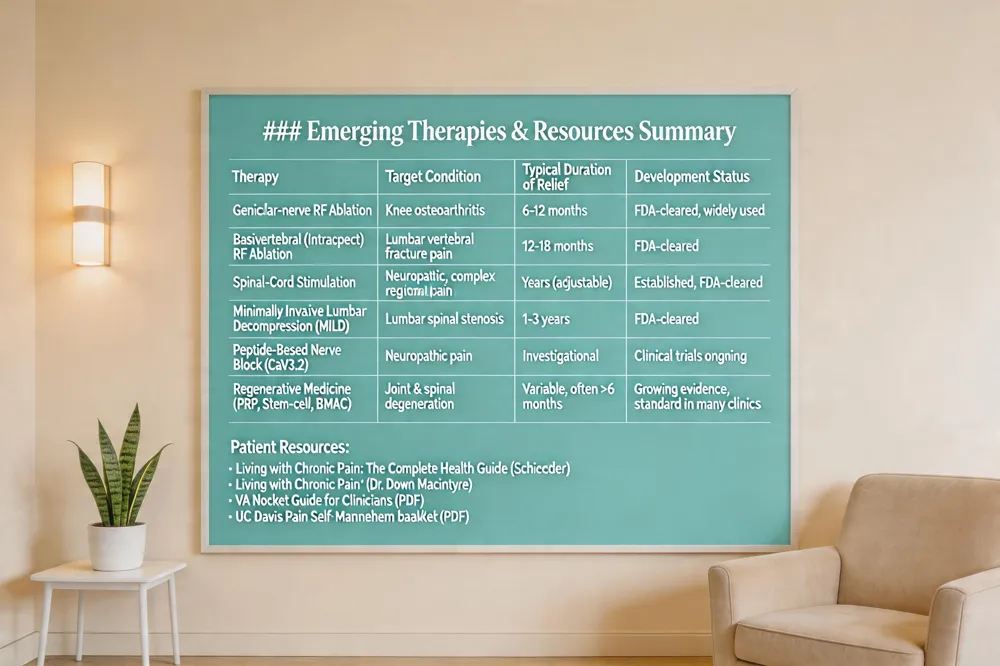 New pain management procedures are shifting the focus from long‑term medication to targeted, minimally invasive interventions. Techniques such as genicular‑nerve radiofrequency ablation for knee pain, basivertebral (Intracept) nerve ablation for lumbar spine pain, and spinal‑cord stimulation or minimally invasive lumbar decompression (MILD) provide relief for months to years without open surgery. Emerging peptide‑based nerve‑block therapies that silence pain‑specific channels (CaV3.2) are also under investigation.
Regenerative medicine offers biologic options that promote tissue repair and durable pain reduction. Platelet‑rich plasma (PRP), stem‑cell, and bone‑marrow‑concentrate injections are now standard components of multidisciplinary programs at specialist centers such as the California Pain Institute, showing modest but statistically significant improvements in joint and spinal pain.
Patient‑focused literature empowers individuals to take an active role in their care. "Living with Chronic Pain: The Complete Health Guide" by Jennifer Schneider and Dr. Dawn Macintyre’s memoir "Living with Chronic Pain" provide science‑based explanations, pacing strategies, and coping tools. downloadable "are," PDFs—like the VA Pocket Guide for Clinicians and UC Davis Pain Self‑Management booklet—summarize assessment tools, stepped‑care models, and self‑management exercises that can be shared during clinic visits.
A pain management physician is formally known as a pain management physician or pain medicine doctor, board‑certified in anesthesiology, neurology, or physical medicine and rehabilitation, with additional fellowship training in pain medicine and often interventional techniques.
A Path Forward with Specialist Care
Specialist pain clinics have reshaped chronic‑pain treatment by integrating advanced diagnostics, targeted interventional procedures, and multidisciplinary rehabilitation. Board‑certified physicians, together with physical therapists, psychologists, and pharmacists, deliver personalized plans that address neurophysiological mechanisms such as central sensitization, reduce opioid reliance, and improve functional outcomes. Studies consistently show 30‑40 % greater pain relief, 20‑25 % lower opioid escalation, and higher satisfaction scores compared with primary‑care alone. Early referral—ideally within three to six months of symptom onset—prevents chronification, shortens disability, and empowers patients to adopt self‑management skills. By educating individuals about neurobiology, pacing, and coping strategies, specialists foster confidence, active participation, and sustained quality of life. Continuous follow‑up ensures treatments stay effective and goals remain realistic.