Why Digital Self‑Management Matters
Persistent pain affects roughly one‑in‑five U.S. adults, and in Los Angeles an estimated 1.6 million residents live with chronic discomfort. Mobile apps and wearable sensors give patients real‑time insight into pain intensity, medication usage, activity, sleep and stress, enabling rapid identification of triggers and personalized pacing. Features such as guided meditation, CBT exercises, and automated reminders improve self‑efficacy while data visualizations empower users to set SMART goals. At the California Pain Institute, clinicians receive encrypted summaries from HIPAA‑compliant apps and wearables, allowing seamless incorporation of symptom trends into multidisciplinary treatment plans. This integration supports timely medication adjustments, targeted physical‑therapy referrals, and ongoing tele‑health communication, making digital self‑management a cost‑effective bridge between home monitoring and expert care. Patients also benefit from secure data export for clinician review, fostering collaborative decision‑making and sustained engagement.
Fundamental Self‑Management Resources
Self‑Management Resources Summary
| Resource | Format | Key Features | Link |
|---|---|---|---|
| Coping skills for chronic pain | Pacing, task chunking, rest breaks, hydration, nutrition, constipation monitoring, CBT exercises, relaxation, mood‑tracking, "Pain Self‑Management Strategies Wheel" | N/A | |
| Pain management strategies handout | Activity pacing, daily relaxation (deep breathing, progressive muscle relaxation, guided imagery), nutrition/hydration, gentle stretching, low‑impact exercise, heat/cold/massage, medication coordination, outcome tracking | N/A | |
| Pain management techniques | Comprehensive non‑pharmacologic strategies (pacing, exercise, mindfulness, CBT, acupuncture, massage, yoga), self‑rating wheel, action‑plan worksheet | https://uspainfoundation.org/blog/10-best-apps-for-people-with-chronic-pain/ | |
| Chronic pain management | Evidence‑based guidelines, stepped‑care model, multimodal strategies, opioid safety (ASA, ASRA‑PM, VA Pocket Guide) | N/A | |
| The Pain Toolkit | Web/Printable booklets, e‑books, audiobooks | 12 self‑management tools (education, activity, sleep, nutrition, mood, flare‑up management) | https://www.paintoolkit.org/ |
| Chronic Pain Toolkit | Web/Printable booklets, e‑books, audiobooks | Same 12 tools as above, clinician‑patient partnership focus | N/A |
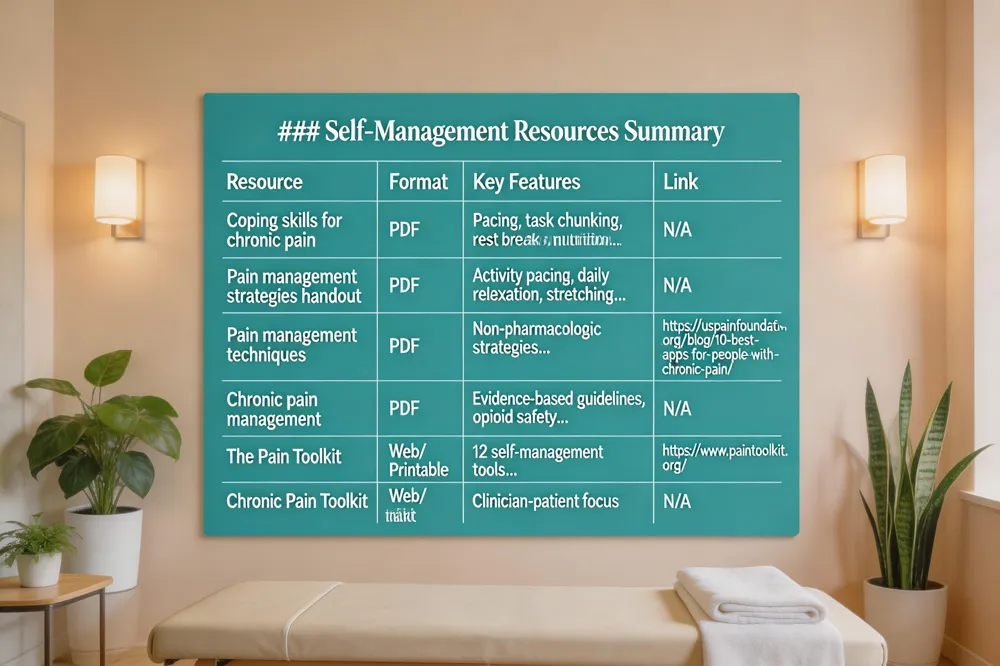 Self‑management tools for chronic pain are essential complements to clinical care. Coping skills for chronic pain PDF provides a step‑by‑step plan that includes pacing activities, breaking tasks into smaller steps, regular rest breaks, hydration, balanced meals, and constipation monitoring. It also offers CBT exercises, relaxation training, mood‑tracking worksheets, and a "Pain Self‑Management Strategies Wheel" for tracking progress over time.
Pain management strategies handout begins with activity pacing guidance, daily relaxation techniques (deep breathing, progressive muscle relaxation, guided imagery), nutrition and hydration advice, and non‑pharmacologic options such as gentle stretching, low‑impact exercise, heat, cold, and massage. It emphasizes coordination with prescribed medication and the importance of tracking outcomes and communicating with providers.
Pain management techniques PDF outlines a comprehensive set of non‑pharmacologic strategies—pacing, exercise, mindfulness, CBT, acupuncture, massage, yoga—alongside practical tools like a self‑rating wheel and action‑plan worksheet. It can be downloaded from the California Pain Institute website.
Chronic pain management PDF compiles evidence‑based guidelines and treatment algorithms from professional societies (e.g., ASA, ASRA‑PM) and the VA Pocket Guide, offering a concise stepped‑care model, multimodal strategies, and opioid safety recommendations.
The Pain Toolkit and Chronic Pain Toolkit each offer collections of printable booklets, e‑books, and audiobooks covering twelve practical self‑management tools—education, activity, sleep, nutrition, mood, and flare‑up management—designed to empower patients, support clinician‑patient partnership, and improve functional outcomes.
Top Pain‑Tracking Apps and Free Options
Top Pain‑Tracking Apps (Free/Low‑Cost)
| App | Cost | Core Features | Data Export / Clinician Sharing | Link |
|---|---|---|---|---|
| PainScale | Free (doctor‑backed) | Intensity, triggers, meds, activity, mood, sleep diary; personalized clinician reports; article/video library | Export PDF, share via secure link | https://painscale.com |
| Pathways Pain Relief | Free tier / paid subscription | Pain tracking, mindfulness, physiotherapy videos, CBT breathing exercises | Export CSV/PDF, share with care team | https://play.google.com/store/apps/details?id=pathways.painrelief |
| Branch (formerly Ouchie) | Free | Pain, meds, activity logging; CBT tools; share reports with team | Export PDF, secure sharing | https://branchapp.com |
| Manage My Pain | Free (ad‑free) | 1‑minute logging, clear charts, trend analysis, HIPAA‑compliant | Secure export to clinicians, optional deeper insights | https://managemypainapp.com |
| ReLeaf | Free | Cannabis tracking, symptom logging | Export CSV | https://releafapp.com |
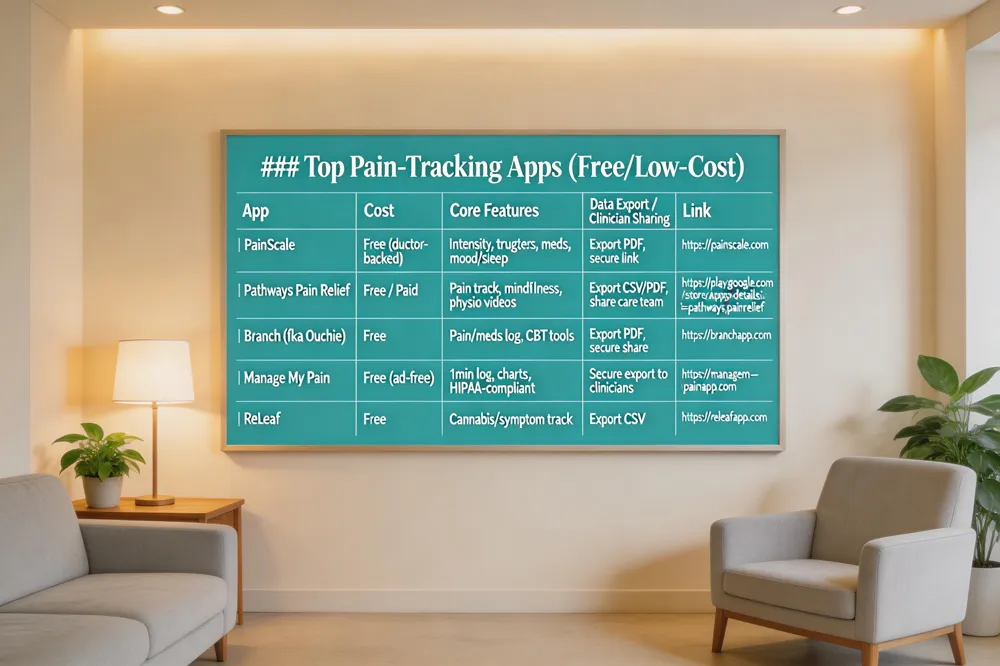 PainScale is a free, doctor‑backed chronic‑pain tracker that lets users record intensity, triggers, medication, activity, mood and sleep in a digital diary. It produces personalized reports for clinicians and offers a searchable library of articles, videos and meditations. Pathways Pain Relief, also free to download, combines pain‑tracking with evidence‑based mindfulness, physiotherapy videos and CBT‑style breathing exercises; the basic tier provides substantial education while a subscription unlocks the full library. Branch (formerly Ouchie) is a free iOS/Android app that logs pain, medications and daily activities, shares reports with your care team, and includes CBT tools for functional improvement. Manage My Pain offers an ad‑free, HIPAA‑compliant experience: quick one‑minute logging, clear charts, trend analysis and secure export of data to clinicians; optional upgrades add deeper insights. For patients seeking completely free solutions, Branch, ReLeaf (cannabis tracking), and the free version of Manage My Pain provide robust tracking without cost. These tools empower chronic‑pain sufferers in Los Angeles to monitor patterns, communicate with the California Pain Institute, and support personalized, evidence‑based self‑management.
Specialized Apps for Comprehensive Care
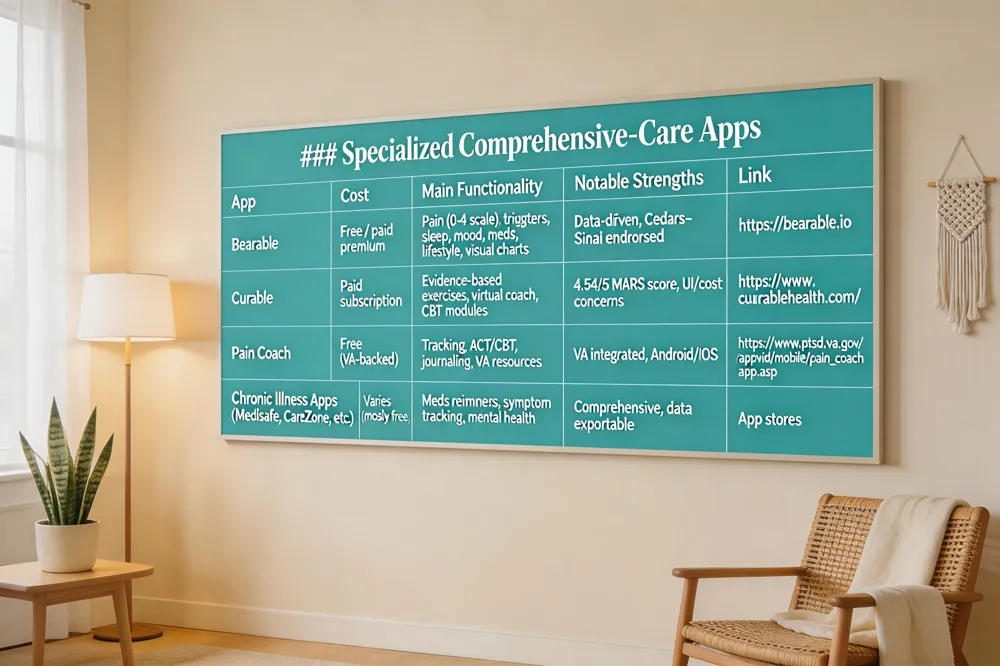
Specialized Comprehensive‑Care Apps
| App | Cost | Main Functionality | Notable Strengths | Link |
|---|---|---|---|---|
| Bearable | Free / paid premium | Pain (0‑4 scale), triggers, sleep, mood, meds, lifestyle; visual charts & reports | Data‑driven, endorsed by Cedars‑Sinai | https://bearable.io |
| Curable | Paid subscription | Evidence‑based exercises, virtual coach, meditations, CBT modules | High MARS score (4.54/5), but UI clutter & cost concerns | https://www.curablehealth.com/ |
| Pain Coach | Free (VA‑backed) | Education, daily mood/pain tracking, interactive ACT/CBT activities, journaling, support network | Integrated with VA resources, Android & iOS | https://www.ptsd.va.gov/appvid/mobile/pain_coach_app.asp |
| Best apps for chronic illness (e.g., Medisafe, CareZone, MyPainDiary, Fitbit, MyFitnessPal, Headspace) | Varies (mostly free) | Medication reminders, symptom tracking, lifestyle monitoring, mental‑health support | Comprehensive ecosystem, data exportable | Various app stores |
 Bearable pain
Bearable lets you record pain levels on a simple 0‑to‑4 scale (none, mild, moderate, severe, unbearable). Entries are automatically visualized in charts and reports, highlighting triggers such as activity, diet, or stress. The data can be exported or shared with your pain‑medicine physician at the California Pain Institute, turning subjective reports into actionable insights. Bearable also links pain to sleep, mood, medication, and lifestyle, enabling you to test strategies that truly reduce discomfort; clinicians at Cedars‑Sinai endorse its data‑driven approach.
Curable app negative reviews
Curable app While many users praise Curable’s evidence‑based exercises and virtual coach, some criticize its subscription cost, calling it high for a long‑term program. A few report a cluttered, unintuitive interface that makes locating meditations difficult. Others note that promised pain relief does not always materialize, especially for severe fibromyalgia or chronic back pain, and that personalized plans can feel generic and slow to adapt. The main complaints focus on cost, usability, and occasional lack of measurable improvement.
Pain Coach app
Pain Coach app is a free, VA‑backed mobile tool that blends evidence‑based education, daily mood and pain tracking, and interactive practice activities targeting thoughts, feelings, and behaviors. Users log pain, journal reflections, and build a support network via step‑by‑step guides and a multimedia journal. Designed to complement professional care, it is available on Android and iOS, with support through the VA’s National Center for Pain Coach.
Best apps for chronic illness
Top chronic‑illness apps combine medication reminders (Medisafe, CareZone), symptom tracking (MyPainDiary), lifestyle monitoring (Fitbit, MyFitnessPal), and mental‑health support (Headspace). These tools help patients manage pain, medication adherence, diet, activity, sleep, and stress, providing comprehensive support for chronic‑pain management. The data can be exported or shared with your pain‑medicine physician at the California Pain Institute, turning subjective reports into actionable insights.
Wearable Technologies and Integration
Wearable Technologies Overview
| Device / Tech | Type | Key Benefits | Integration & Data Flow | Link |
|---|---|---|---|---|
| iReliev Wireless TENS + EMS | Wearable TENS/EMS | Non‑invasive analgesia, portable, wireless, supports movement | Data via companion app (HIPAA‑compliant) | https://ireliev.com |
| Apple Watch (with HealthKit) | Smartwatch | HR, activity, sleep, predictive pain modeling (Random Forest, 84.5 % accuracy) | Secure API to EHR, HIPAA‑compliant | https://apple.com/watch |
| Fitbit | Smartwatch/Tracker | HRV, activity, sleep, data encryption, ISO 27001/GDPR | Sync to HIPAA‑ready platforms | https://fitbit.com |
| Inceptiv™ Spinal Cord Stimulator | Implantable neurostimulator | Closed‑loop neural sensing, posture‑based adaptive stimulation | Clinician‑controlled via secure portal | https://inceptiv.com |
| Visible band | Wearable band | Passive HR, activity, sleep, low‑cost | Export CSV, integrate via APIs | https://www.makevisible.com/ |
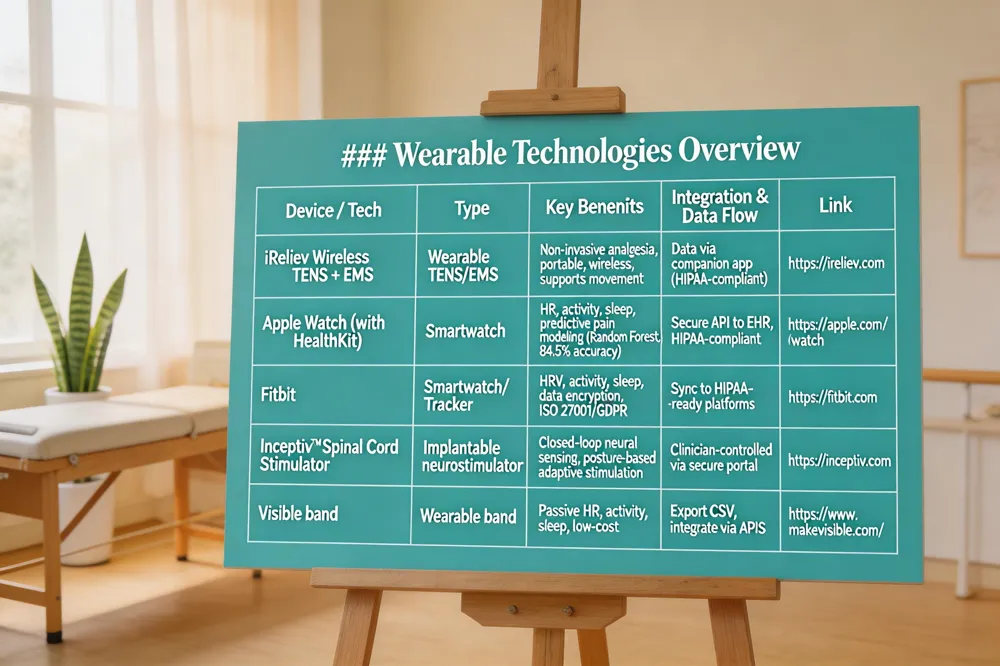 Wearable TENS devices have become a practical adjunct to chronic‑pain programs. Compact, battery‑powered units such as the iReliev Wireless TENS + EMS combo deliver mild electrical pulses through skin‑adhesive electrodes, interrupting pain signals and stimulating endogenous endorphin release. FDA‑cleared and wireless, they allow patients to move freely while treating back, shoulder, knee or arthritic pain, reducing reliance on oral medications.
Predictive models using wearables are advancing pain forecasting. Random‑Forest algorithms applied to continuous heart‑rate, activity and sleep data have achieved accuracies up to 84.5 %, while multilevel regression links nightly heart‑rate variability to next‑day pain intensity. Integrating these models with patient‑reported outcomes enables proactive, personalized interventions.
Data security and HIPAA compliance are essential. Wearables and companion apps must encrypt data in transit, meet ISO 27001/GDPR standards and allow users to request data deletion. Devices such as the Apple Watch and Fitbit now support HIPAA‑compliant data sharing when paired with certified apps.
Integration with electronic health records (EHR) creates a unified view of symptoms, activity and medication use. Secure APIs allow automatic upload of pain‑diary entries, wearable‑derived metrics and clinician notes, facilitating remote monitoring and timely treatment adjustments.
Wearable TENS: Wearable TENS devices deliver mild electrical pulses through adhesive skin electrodes, providing non‑invasive analgesia that can be tailored to individual conditions and used under physician guidance.
What is the new device for chronic pain?: The Inceptiv™ spinal cord stimulator uses closed‑loop neural‑sensing to automatically adjust stimulation based on posture and movement, offering adaptive pain relief.
How to control pain mentally: Practicing deep‑breathing, mindfulness meditation, guided imagery, positive self‑talk and distraction techniques helps re‑frame pain perception and reduce nervous‑system alarm responses.
What are the 5 A's of chronic pain?: 5 A's of chronic pain: Analgesia, activities of daily living, adverse effects, affect, and aberrant drug‑related behaviors.
Evidence Base and Clinical Outcomes
Evidence & Clinical Outcomes Snapshot
| Study / Metric | Findings | Apps / Devices Evaluated | Source |
|---|---|---|---|
| NZ app review (939 apps) | Median SMS‑14 score 4/14; only 19 met criteria; top apps scored 8/14 | Curable, PainScale‑Pain Diary & Coach, SuperBetter | https://pmc.ncbi.nlm.nih.gov/articles/PMC6390192/ |
| 12‑month wearable study (Apple Watch, Pillow, custom Pain Watch) | ↓ Depression (‑7.8 PHQ‑9), ↓ Opioid use (‑21 MME/yr) when combined with multidisciplinary program | Apple Watch, Pillow, custom Pain Watch | https://pmc.ncbi.nlm.nih.gov/articles/PMC9645546/ |
| Curable RCT | Significant pain reduction, highest MARS score (4.54/5) | Curable | https://pmc.ncbi.nlm.nih.gov/articles/PMC6390192/ |
| MARS rating of 19 apps | Top 3 (Curable, PainScale‑Pain Diary & Coach, SuperBetter) reached 8/14 on behavior‑change checklist | Curable, PainScale, SuperBetter | https://pmc.ncbi.nlm.nih.gov/articles/PMC6390192/ |
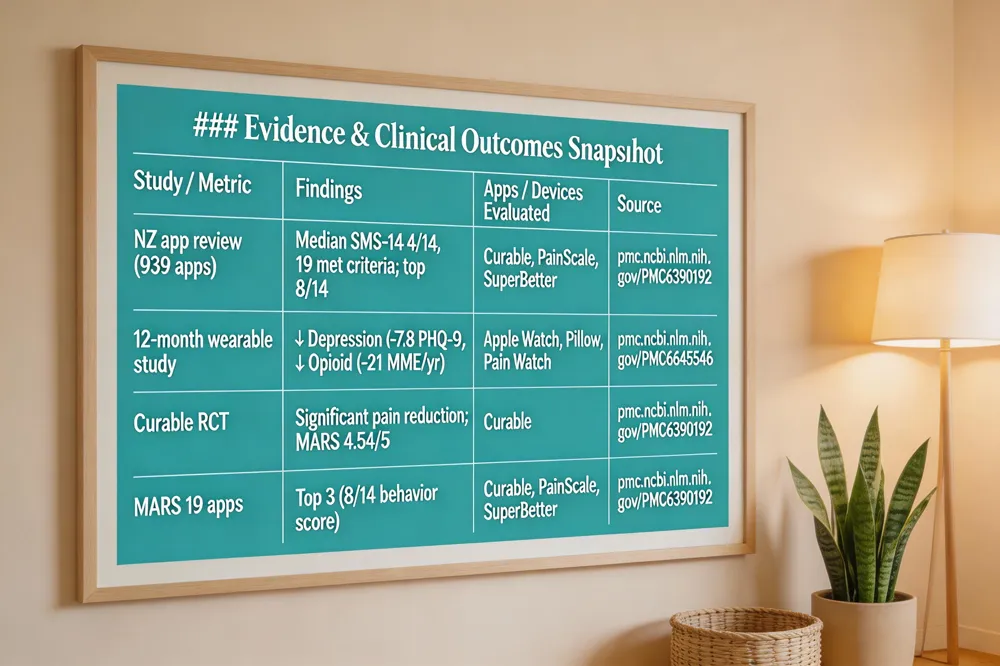 Reviews find most apps include 2–15 behavior‑change techniques, especially mindfulness and CBT. In a New Zealand search of 939 apps, only 19 met criteria for persistent‑pain self‑management; they scored a median of 4/14 on the SMS‑14 checklist (range 1‑8). The top‑scoring apps—Curable, PainScale‑Pain Diary & Coach, and SuperBetter—reached 8/14 and were free, suggesting scalable options. A 12‑month study of wearable use (Apple Watch, Pillow, custom Pain Watch) showed significant reductions in depression (‑7.8 PHQ‑9) and opioid use (‑21 MME/year) when paired with a multidisciplinary program. Curable’s RCT confirmed efficacy and earned the highest MARS score (4.54/5) among 19 apps.
Negative Curable reviews cite subscription cost, UI clutter and occasional lack of relief. Pain‑management apps such as Branch, Pathways Pain Relief, Bearable and Manage My Pain provide tracking, education and clinician‑sharing, while the VA‑backed Pain Coach offers evidence‑based CBT and ACT tools. PainScale is a diary with Health‑Kit integration, and Manage My Pain is viewed as the best tracker for logging, reports and Pain Guide.
Putting It All Together: Practical Guidance for CPI Patients
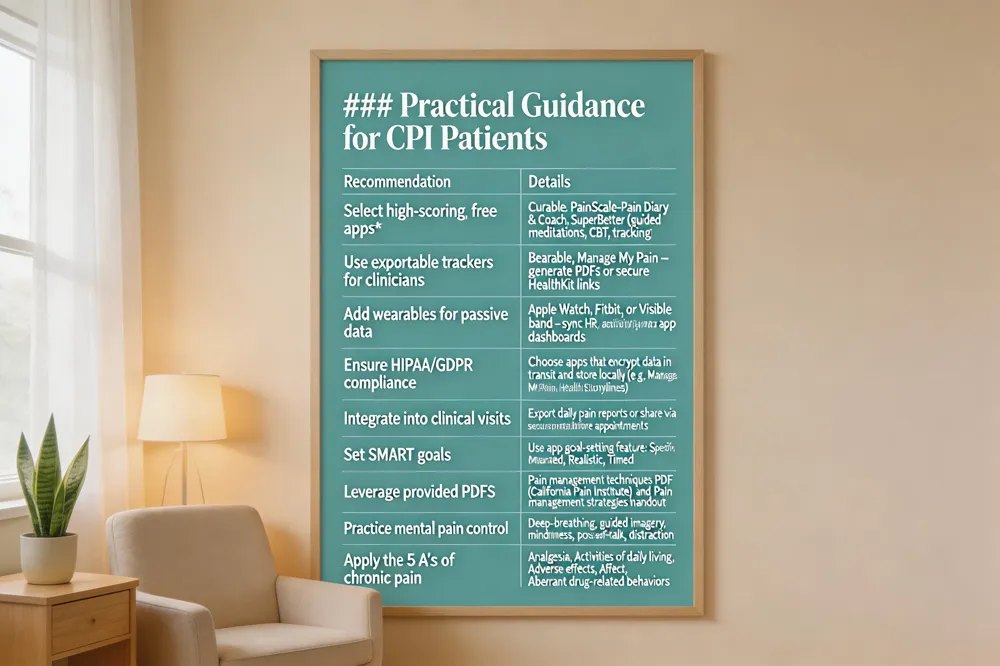
Practical Guidance for CPI Patients
| Recommendation | Details |
|---|---|
| Select high‑scoring, free apps | Curable, PainScale‑Pain Diary & Coach, SuperBetter (guided meditations, CBT, tracking) |
| Use exportable trackers for clinicians | Bearable, Manage My Pain – generate PDFs or secure HealthKit links |
| Add wearables for passive data | Apple Watch, Fitbit, or Visible band – sync HR, activity, sleep to app dashboards |
| Ensure HIPAA/GDPR compliance | Choose apps that encrypt data in transit and store locally (e.g., Manage My Pain, Health Storylines) |
| Integrate into clinical visits | Export daily pain reports or share via secure portal before appointments |
| Set SMART goals | Use app goal‑setting feature: Specific, Measurable, Action‑oriented, Realistic, Timed |
| Leverage provided PDFs | Pain management techniques PDF (California Pain Institute) and Pain management strategies handout for pacing, relaxation, nutrition |
| Practice mental pain control | Deep‑breathing, guided imagery, mindfulness, positive self‑talk, distraction techniques |
| Apply the 5 A’s of chronic pain | Analgesia, Activities of daily living, Adverse effects, Affect, Aberrant drug‑related behaviors |
 Choosing the right app and wearable
Select tools that match your needs: free, high‑scoring apps such as Curable, PainScale‑Pain Diary and Coach, or SuperBetter offer guided meditations, CBT modules, and pain‑tracking dashboards, while Bearable and Manage My Pain provide exportable graphs for clinician review. Wearables (Apple Watch, Fitbit, or Visible band) add passive heart‑rate, activity, and sleep data that enrich self‑monitoring.
Data privacy and HIPAA compliance
Only apps that encrypt data in transit and store it on the device (e.g., Manage My Pain, Health Storylines) meet HIPAA, GDPR, and ISO standards; avoid platforms that sell health data without explicit consent.
Integrating tools into clinical visits
Export daily pain reports or sync via Apple HealthKit, then share the PDF or secure portal link with your CPI provider. This enables real‑time adjustments to medication, pacing, and therapeutic exercises.
Self‑efficacy and goal setting
Use SMART goals (Specific, Measurable, Action‑oriented, Realistic, Timed) within the app’s goal‑setting feature to boost confidence and track progress.
Pain management techniques PDF
The downloadable PDF from the California Pain Institute outlines pacing, exercise, mindfulness, CBT, acupuncture, massage, yoga, hydration, nutrition, and an action‑plan worksheet for use with your clinician.
Pain management strategies handout
Focus on breaking tasks into small steps, regular relaxation (deep breathing, progressive muscle relaxation), balanced meals, low‑impact activity, and coordinated medication tracking. handout
How to control pain mentally
Practice deep‑breathing, guided imagery, mindfulness, positive self‑talk, and distraction; seek counseling or group support to reinforce coping.
What are the 5 A's of chronic pain?
Analgesia, Activities of daily living, Adverse effects, Affect, and Aberrant drug‑related behaviors.
Next Steps for Los Angeles Pain Patients
Los Angeles patients should start by choosing tools that match their specific condition and lifestyle. Free, high‑scoring apps such as Curable, PainScale‑Pain Diary, and SuperBetter offer guided meditation, CBT, and pain‑coach features, while paid options like Pathways Pain Relief add physiotherapy videos and yoga modules. Pair these apps with wearables that reliably record activity, heart‑rate variability, and sleep—Apple Watch, Fitbit, or the Visible band are popular choices that integrate directly into the apps. When a patient logs pain scores, medication use, and trigger data, the information can be exported securely (HIPAA‑compliant) and shared through patient portals or directly with the California Pain Institute’s team, enabling real‑time treatment adjustments. Finally, maintain self‑efficacy by setting SMART goals, practicing relaxation techniques, and reviewing progress reports to reinforce confidence in managing pain independently.