Introduction
Chronic pain—defined as pain persisting longer than three months—affects roughly 20% of U.S. adults and is a leading cause of disability, anxiety, and reduced quality of life. Because pain is a multidimensional experience that blends physical, emotional, and social factors, understanding it through real‑world narratives is essential. Patient stories illustrate how individualized, evidence‑based plans can transform daily functioning, lower opioid reliance, and restore hope. At the California Pain Institute (CPI) in Los Angeles, a multidisciplinary team—led by an experienced board‑certified pain‑medicine physician and comprising physical therapists, psychologists, and interventional specialists—delivers coordinated care. This approach integrates medication management, targeted nerve blocks, spinal cord stimulation, regenerative therapies, and behavioral health services, all tailored to each patient’s unique condition and cultural background. By sharing success stories, CPI demonstrates the power of collaborative, patient‑centered treatment in breaking the chronic‑pain cycle and improving long‑term outcomes.
Understanding Chronic Pain and Its Mental Impact
Understanding Chronic Pain and Its Mental Impact
| Aspect | Description | Typical Impact |
|---|---|---|
| Definition | Pain persisting >3 months | ~20 % of U.S. adults experience it |
| Physiological response | Chronic activation of stress pathways (cortisol, adrenaline) | Amplifies pain and emotional distress |
| Mental health effects | Anxiety, depression, sleep disruption, helplessness | Erodes relationships, daily functioning |
| Lifestyle factors | Poor sleep, smoking, alcohol, untreated mood disorders | Worsen pain perception and coping |
| Therapeutic approach | Acceptance, mindful breathing, low‑impact activity, pacing, multidisciplinary team | Improves quality of life and functional ability |
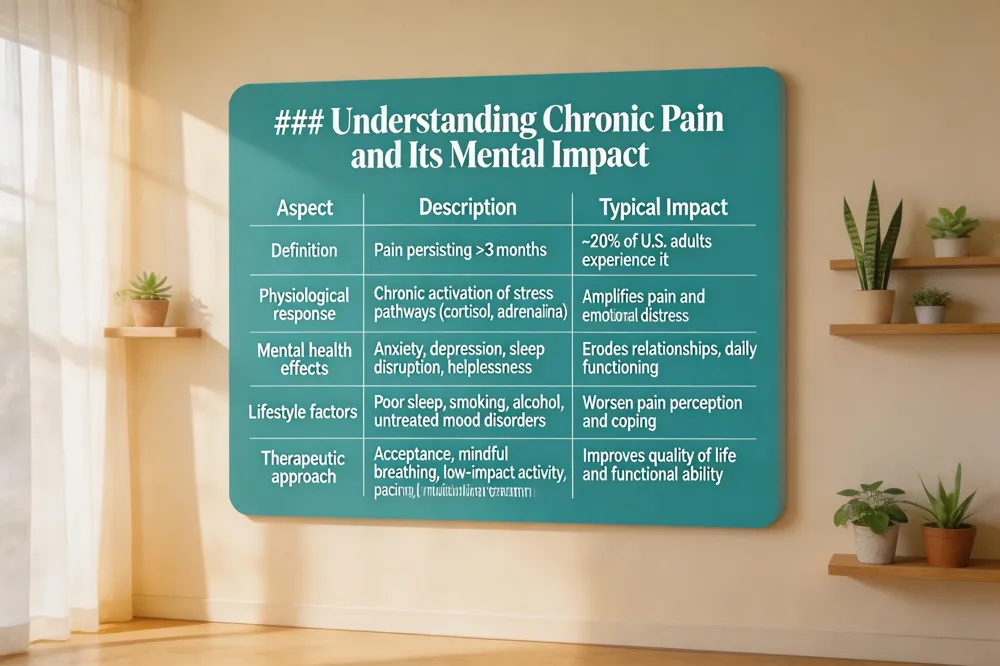 Chronic pain—defined as pain persisting longer than three months—affects roughly 20 % of U.S. adults, making it one of the most common and disabling health conditions. The pain is not merely a physical sensation; it continually engages the brain’s stress pathways, raising cortisol and adrenaline levels that amplify both discomfort and emotional distress. As a result, patients often experience anxiety, depression, sleep disruption, and a sense of helplessness that can erode relationships and daily functioning.
How to come to terms with chronic pain? Acceptance begins with recognizing that pain is real but does not define your whole identity. Mindful breathing and meditation allow you to observe pain without judgment, reducing the stress‑induced amplification. Gentle, low‑impact activity—walking, swimming, yoga—paired with pacing strategies helps rebuild strength while avoiding flare‑ups. Prioritizing sleep hygiene, limiting smoking or alcohol, and treating co‑existing mood disorders with therapy or medication are essential. A supportive multidisciplinary team provides personalized tools and reinforces the belief that you can live a meaningful life despite pain.
What is it like living with chronic pain? Everyday tasks—bending, sitting, or even standing—can trigger intense discomfort, prompting avoidance that leads to muscle weakness and stiffness. This physical limitation often breeds frustration, anxiety, and social withdrawal. Yet, with targeted interventions such as physical therapy, nerve blocks, radiofrequency ablation, or spinal cord stimulation, many patients regain function, return to work, and enjoy hobbies, restoring hope and normalcy.
What does chronic pain do to a person mentally? Persistent pain keeps the brain in a heightened stress state, disrupting neurotransmitters that regulate mood. Anxiety, depressive symptoms, and hopelessness become common, while sleep disturbances impair cognition and emotional resilience. The mental toll can increase reliance on substances for relief, underscoring the need for integrated psychological care alongside medical treatment. Addressing both body and mind is crucial for breaking the pain‑stress cycle and improving overall quality of life.
Mind‑Body Strategies for Pain Control
Mind‑Body Strategies for Pain Control
| Technique | Primary Goal | Example Practice |
|---|---|---|
| Cognitive‑Behavioral Therapy (CBT) | Re‑frame negative thoughts, reduce catastrophizing | Thought‑record worksheets, guided restructuring |
| Progressive Muscle Relaxation | Decrease physiological arousal | Systematic tensing/relaxing muscle groups |
| Deep Breathing / Diaphragmatic Breathing | Lower sympathetic tone | 4‑7‑8 breath cycle, box breathing |
| Guided Imagery | Distract and shift focus away from pain | Visualizing a calm scene while breathing |
| n | Mindfulness‑Based Stress Reduction (MBSR) / ACT | Observe sensations without judgment |
| Enjoyable Low‑Impact Activity | Release endogenous analgesics, break avoidance | Walking 20 min, gentle yoga, swimming laps |
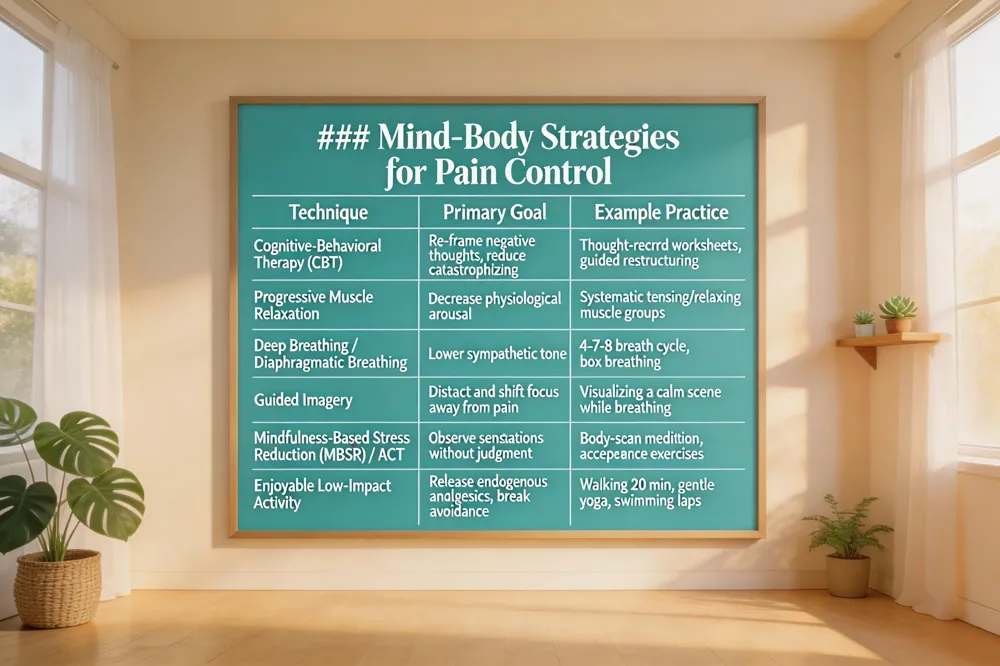 Chronic pain is a biopsychosocial condition, and mind‑body techniques are essential components of a multidisciplinary treatment plan. Cognitive‑behavioral therapy (CBT) helps patients re‑frame negative thoughts, challenge catastrophizing, and replace them with realistic, positive statements about progress. Relaxation methods such as progressive muscle relaxation, guided imagery, and deep‑breathing reduce the physiological stress response that amplifies pain, as shown in Harvard Health and NIH‑backed programs. Mindfulness‑based stress reduction and acceptance‑commitment therapy teach patients to observe sensations without judgment, lowering emotional reactivity and improving quality of life. Engaging in enjoyable activities, hobbies, or low‑impact exercise (walking, swimming, yoga) provides distraction, releases endogenous analgesics, and breaks the pain‑avoidance cycle.
How to control pain mentally? Use Cognitive‑behavioral therapy (CBT) techniques to reframe thoughts, practice relaxation (deep breathing), incorporate Mindfulness‑based stress reduction or ACT to observe pain without judgment, stay active in enjoyable pursuits, and seek supportive connections through friends, support groups, or a pain psychologist.
How to break the chronic pain cycle? Identify and modify pain‑triggering activities, introduce gradual low‑impact exercise, use heat/cold therapy, maintain regular sleep, practice relaxation daily, and partner with a pain‑medicine specialist for personalized medication, interventional, and counseling plans.
What to do when you are in constant pain? Begin gentle movement (walking, light stretching) paired with deep breathing, educate yourself with reputable resources, consider CBT or counseling, keep a stable sleep routine, stay socially connected, and schedule an evaluation with a primary‑care physician or multidisciplinary pain clinic for individualized treatment options.
Medical Interventions at California Pain Institute
Medical Interventions at California Pain Institute
| Modality | Target | Typical Benefit |
|---|---|---|
| Diagnostic nerve blocks & high‑resolution imaging | Identify precise pain generator (facet, SI joint, peripheral nerve) | Enables targeted therapy |
| Epidural steroid injection | Inflammatory spinal pain | Reduces pain & inflammation for weeks‑months |
| Facet‑joint / SI‑joint injection | Joint‑specific nociceptive pain | Immediate relief, improves mobility |
| Radio‑frequency ablation | Nerve signal transmission | Cuts pain scores 50‑70 % for 6‑12 months |
| Spinal‑cord stimulation (SCS) | Refractory neuropathic pain | Long‑term pain reduction, opioid‑sparing |
| Dorsal‑root‑ganglion (DRG) stimulation | Focal neuropathic pain | High‑precision relief, >70 % success in trials |
| Platelet‑rich plasma (PRP) & stem‑cell injections | Tissue repair & inflammation modulation | Potential regenerative benefit, reduced pain |
| Multidisciplinary coordination | Physical therapy, psychology, medication management | Integrated, patient‑centered care plan |
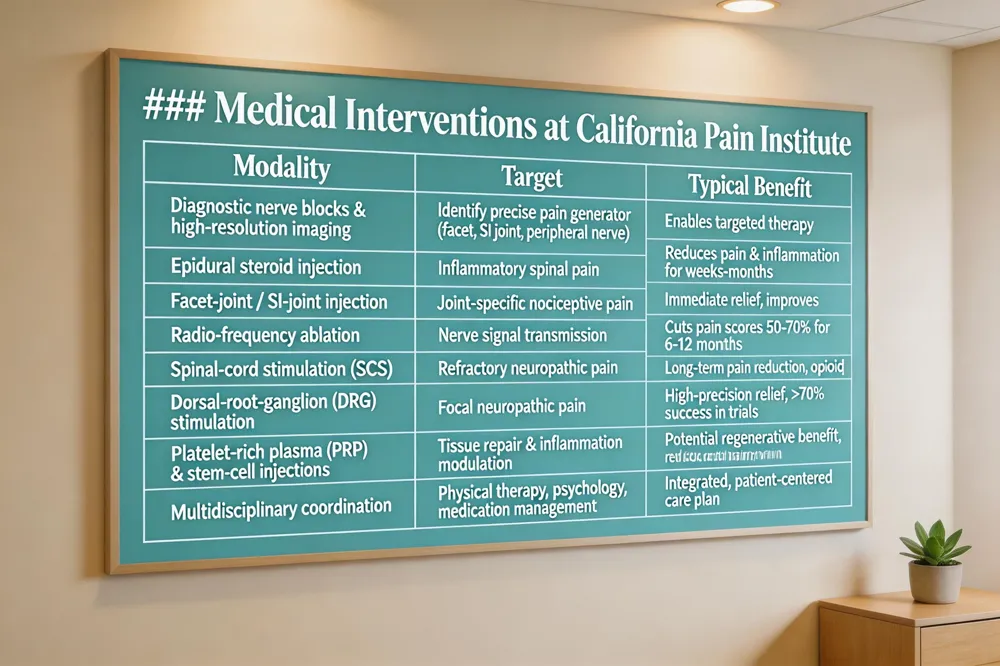 The California Pain Institute (CPI) delivers a full spectrum of evidence‑based therapies for chronic pain. First, diagnostic nerve blocks and high‑resolution imaging (MRI, CT, ultrasound‑guided studies) pinpoint the exact source of pain—whether it is a facet joint, sacroiliac joint or peripheral nerve—so that treatment can be precisely targeted. Interventional procedures include epidural steroid injections, facet‑joint and sacroiliac injections, and radio‑frequency ablation, all performed by board‑certified pain physicians under real‑time imaging guidance. For patients with refractory nociceptive or neuropathic pain, CPI offers neuromodulation such as spinal‑cord stimulation (SCS) and dorsal‑root‑ganglion (DRG) stimulation, which have been shown to cut pain scores by 50‑70 %. Regenerative options—platelet‑rich plasma (PRP) and stem‑cell‑based injections—aim to repair damaged tissue and reduce inflammation, complementing the interventional suite. All of these modalities are coordinated by a multidisciplinary team that includes physicians, physical therapists, psychologists, and rehabilitation specialists, ensuring that medication management, physical therapy, and behavioral health are integrated into a single, patient‑centered care plan. CPI’s secure online portal and insurance liaison services make scheduling, record‑keeping, and follow‑up seamless, while patient testimonials—such as the praise for Dr. Saifullah’s epidural work—highlight the clinic’s compassionate expertise.
Patient Success Stories
Patient Success Stories
| Patient | Provider (CPI) | Key Outcome |
|---|---|---|
| Linda Schmidtke | Dr. Church | Clear treatment choices → functional restoration |
| Mrs. Hook | Multidisciplinary team | Sustained relief after car‑accident trauma |
| Justin White | Dr. Patel | Visual explanations → successful pain‑control plan |
| Steve Turner | Dr. Blauzvern | Prompt MRI & guidance → rapid back‑pain improvement |
| Tim Hooper | Dr. Cowan | Friendly professionalism → opioid‑free status, return to hobbies |
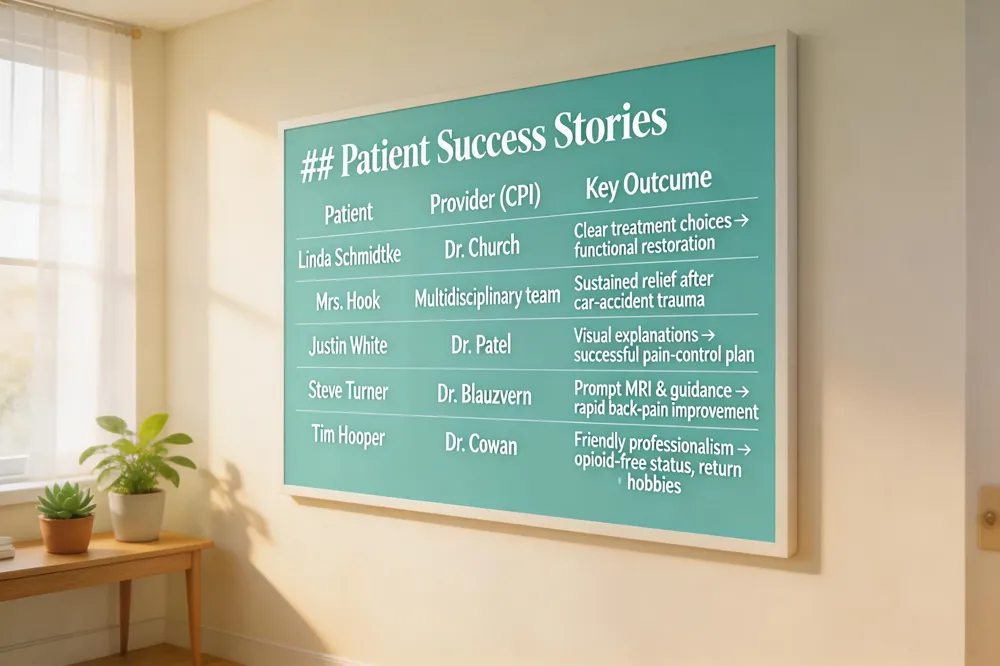 Patient success stories illustrate how individualized care at the California Pain Institute (CPI) transforms lives. Linda Schmidtke credits Dr. Church for empowering her with clear, compassionate treatment choices; Mrs. Hook, a decade‑long car‑accident survivor, highlights the team’s relentless focus on her unique pain, leading to lasting relief; Justin White describes Dr. Patel's visual explanations that guided him to a successful plan; Steve Turner recounts Dr. Blauzvern's prompt MRI and guidance that quickly eased his back pain; and Tim Hooper praises Dr. Cowan's friendly professionalism and supportive staff that smoothed his recovery. These journeys showcase opioid reduction and functional restoration—many patients transition to opioid‑free status while regaining daily activities, work, and hobbies. CPI’s multilingual staff provides culturally competent care across Los Angeles, ensuring communication in patients’ preferred languages. Telehealth visits and community outreach programs expand access for underserved populations, offering virtual education, remote monitoring, and local workshops. Together, these stories affirm that life with chronic pain can be meaningful, and that a multidisciplinary, patient‑centered approach restores purpose, mobility, and quality of life.
When Pain Becomes Overwhelming
When Pain Becomes Overwhelming
| Warning Sign | Immediate Action | Rationale |
|---|---|---|
| Sudden severe spike affecting breathing, movement, cognition | Call 911 or go to ER | Potential medical emergency (e.g., spinal cord compression) |
| Loss of sensation or new weakness | Seek urgent medical evaluation | May indicate nerve injury or vascular issue |
| Fever, swelling, redness at pain site | Contact urgent‑care or physician | Possible infection requiring antibiotics |
| Overwhelming hopelessness or self‑harm thoughts | Call 988 Suicide & Crisis Lifeline (phone/text/chat) | Immediate mental‑health crisis intervention |
| Rapid worsening not emergent | Call pain‑medicine physician or urgent‑care clinic | Adjust meds or schedule interventional treatment |
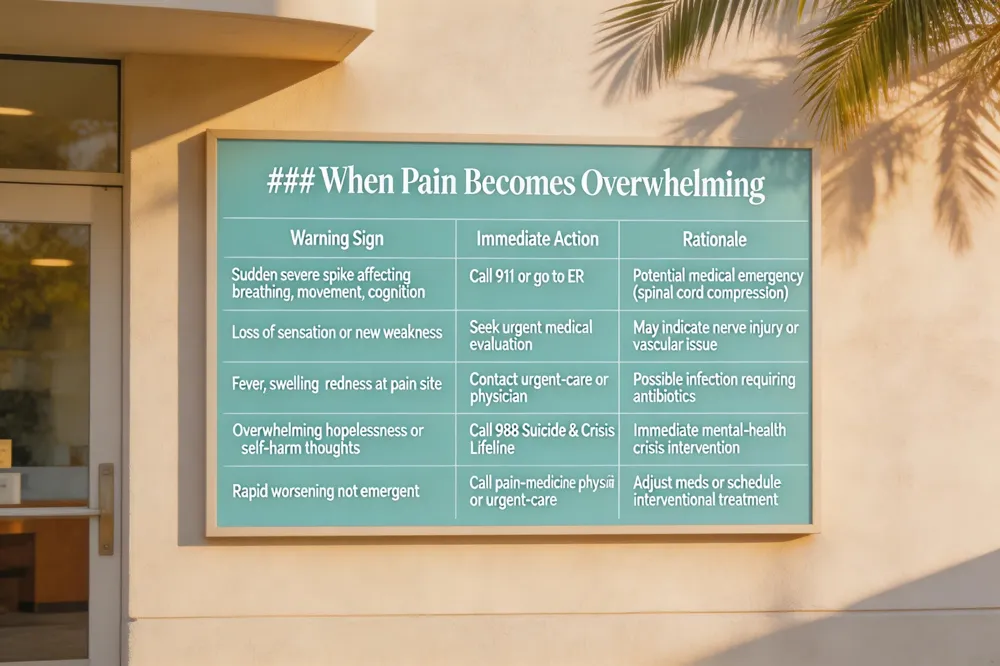 Chronic pain can shift from a manageable nuisance to an urgent health crisis. Emergency warning signs include a sudden, severe spike that interferes with breathing, movement, or clear thinking; loss of sensation; or any sign of infection such as fever or swelling. If these occur, call 911 or go to the nearest emergency department. For less extreme but still rapid worsening, contact your pain‑medicine physician or an urgent‑care clinic promptly so medications or interventional treatments can be adjusted.
Crisis resources and safety planning are essential when pain triggers overwhelming hopelessness or thoughts of self‑harm. Reach out immediately to the 988 Suicide & Crisis Lifeline (call, text, or chat) and keep a list of trusted contacts, coping strategies, and crisis numbers handy. The California Pain Institute’s multidisciplinary team can help you develop a personalized safety plan that addresses both physical and emotional needs.
Progression of chronic pain often involves central sensitization, where the nervous system becomes hyper‑responsive, amplifying pain signals even after tissue healing. Untreated factors—poor posture, inactivity, stress, or mental‑health issues—can accelerate this cycle, but early, targeted therapy can halt or reverse it.
Healing timelines vary. Some patients notice improvement within weeks to months of a combined regimen of medication, physical therapy, behavioral health, and interventional procedures, while others require long‑term management. The goal is meaningful relief and restored function, not necessarily complete pain elimination. Early, individualized, multidisciplinary care offers the best chance for a better quality of life.
Holistic Living and Future Directions
Holistic Living and Future Directions
| Practice | Benefit | Implementation Tip |
|---|---|---|
| Activity pacing (short purposeful tasks + rest) | Prevents boom‑bust cycle, maintains independence | Use a timer: 15 min activity → 5 min rest |
| Sleep hygiene (consistent schedule, dark cool room, limited screens) | Reduces nocturnal pain spikes, lowers cortisol | Set wind‑down routine 30 min before bed |
| Substance moderation (no nicotine, limited alcohol) | Improves circulation, reduces opioid need | Replace smoking breaks with brief walks |
| Community & telehealth support | Increases access, emotional validation | Join virtual support groups, schedule monthly tele‑visits |
| Emerging neuromodulation (DRG, next‑gen SCS) | Higher pain‑relief percentages, fewer side‑effects | Discuss eligibility with pain‑medicine specialist |
| Regenerative therapies (PRP, stem‑cell) | Potential tissue repair, decreased inflammation | Consider clinical trial enrollment if appropriate |
| AI‑driven predictive analytics | Personalized medication & early intervention | Stay informed about research updates from CPI |
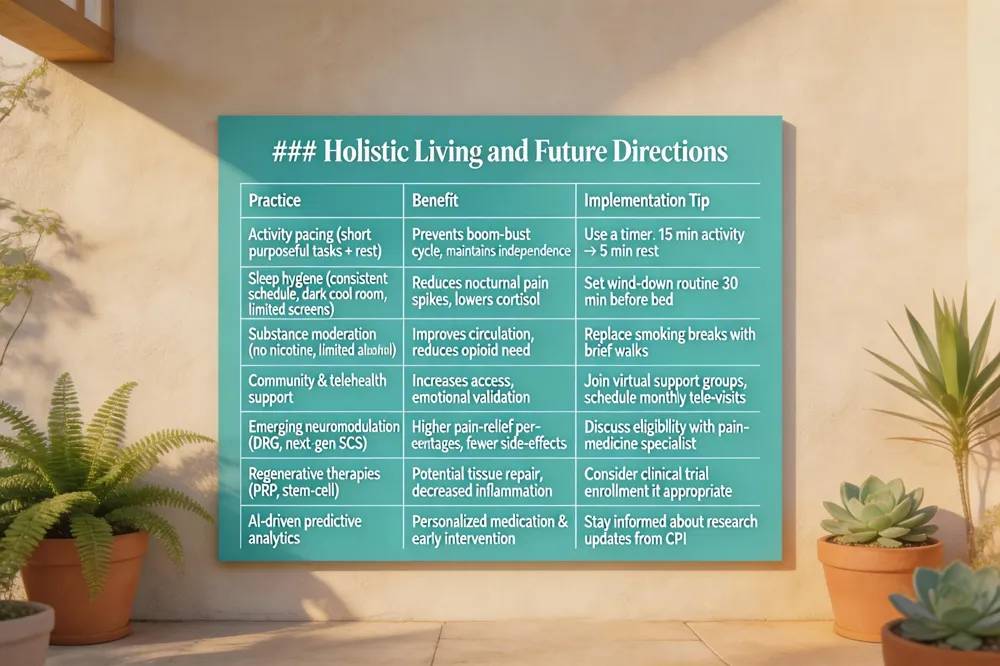 A sustainable daily routine is a cornerstone of chronic‑pain self‑management. Patients are encouraged to break the day into short, purposeful activities—such as gentle stretching, short walks, or light household tasks—followed by scheduled rest periods. This pacing strategy prevents the "boom‑bust" cycle that amplifies pain and deconditions muscles, while still maintaining functional independence.
Sleep hygiene and substance moderation are equally vital. Consistent bedtime and wake‑time cues, a cool‑dark bedroom, and limiting screen exposure before sleep help reduce nocturnal pain spikes linked to heightened cortisol levels. Avoiding nicotine and excessive alcohol, which impair circulation and nerve function, further supports restorative sleep and reduces the need for high‑dose opioids.
Community support and telehealth have expanded access to multidisciplinary care in Los Angeles and beyond. Virtual visits enable regular follow‑up with physicians, physical therapists, and pain psychologists, while online support groups provide emotional validation and coping ideas. Local outreach programs—such as those offered by the California Pain Institute—offer multilingual education workshops and tele‑rehabilitation sessions for underserved neighborhoods.
Looking ahead, emerging innovations promise to reshape pain care. Neuromodulation advances, including dorsal‑root‑ganglion stimulation and next‑generation spinal cord stimulators, are delivering higher pain‑relief percentages with fewer side‑effects. Regenerative therapies—platelet‑rich plasma and stem‑cell injections—are being studied for joint degeneration and neuropathic pain. Artificial‑intelligence‑driven predictive analytics may soon personalize medication regimens and identify patients who will benefit most from early interventional procedures. Together, these developments aim to reduce opioid reliance, restore function, and improve long‑term quality of life for chronic‑pain sufferers.
Conclusion
Effective chronic‑pain management hinges on a few core strategies: a thorough assessment of the underlying condition, a multimodal treatment plan that blends medication, interventional procedures, physical therapy, and behavioral health, and ongoing patient education to empower self‑care. The stories from the California Pain Institute, Johns Hopkins, UAMS, and other centers consistently show that when patients engage with a multidisciplinary team, they can reduce opioid reliance, regain function, and improve quality of life. If you are living with persistent pain, seek out a pain‑medicine specialist who coordinates physicians, therapists, psychologists, and interventional experts—ideally in a clinic that offers culturally competent, evidence‑based care. Modern pain medicine provides a hopeful outlook: advances such as spinal‑cord stimulation, targeted nerve blocks, and mind‑body therapies have helped countless individuals move from hopelessness to renewed activity and independence. Take the first step today by consulting a qualified pain‑management center and partnering in a personalized recovery journey.