Welcome to Cryoanalgesia Innovations at California Pain Institute
Cryoanalgesia, also known as cryoneurolysis, is a minimally invasive, image‑guided technique that applies extreme cold (‑70 °C to ‑100 °C) to peripheral sensory nerves. The rapid cooling creates reversible Wallerian degeneration while preserving the nerve sheath, allowing natural regeneration over weeks to months and providing analgesia lasting from three to twelve months.
The purpose of this article is to introduce patients and clinicians to the role of cryoanalgesia within a comprehensive, multimodal pain‑management program. By highlighting its mechanism, safety profile, and evidence‑based outcomes, we aim to clarify how this technology can complement medication, physical therapy, and behavioral strategies to achieve lasting pain relief.
Scope of chronic pain management at the California Pain Institute includes neuropathic conditions (post‑mastectomy pain, intercostal neuralgia, trigeminal neuralgia), postoperative pain after thoracic or orthopedic surgery, and musculoskeletal syndromes such as knee osteoarthritis. Cryoanalgesia offers a non‑opioid, repeatable option that reduces opioid consumption, minimizes neuroma risk, and fits comfortably into outpatient care. Our multidisciplinary team ensures proper patient selection, precise ultrasound or fluoroscopic targeting, and coordinated follow‑up to maximize functional recovery and quality of life.
Integrating Cryoanalgesia into Comprehensive Pain Management
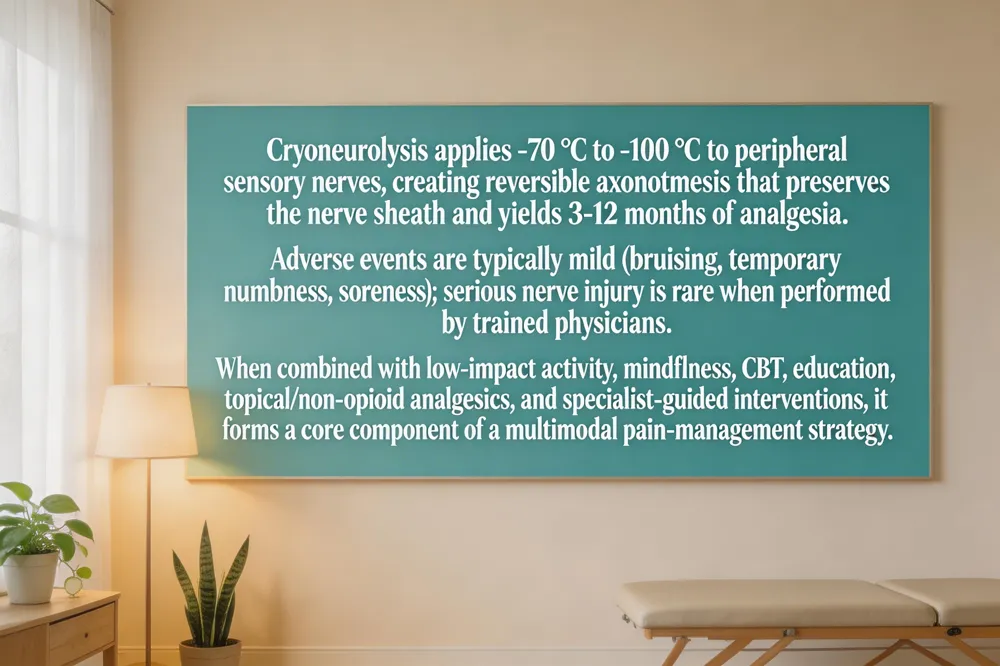 Cryoneurolysis works by applying extreme cold (‑70 °C to ‑100 °C) to a peripheral sensory nerve, creating a reversible axonotmesis that disrupts pain signal conduction while preserving the nerve sheath. This allows natural regeneration over weeks to months and provides analgesia lasting 3‑12 months. The safety profile is favorable: most adverse events are mild, including transient bruising, temporary numbness, and soreness at the probe site; rare complications such as skin discoloration, prolonged numbness, or brief motor weakness resolve with time, and permanent nerve injury is exceedingly uncommon when performed by trained physicians.
What are the best pain management techniques? A multimodal approach works best: low‑impact activities (walking, swimming, yoga) paired with breathing, mindfulness, or progressive muscle‑relaxation; cognitive‑behavioral or other talking therapies; educational resources and support groups; judicious use of topical or non‑opioid analgesics; and specialist‑guided interventions like nerve blocks or cry oanalgesia for targeted relief.
Cryoneurolysis side effects: The procedure is generally well‑tolerated. Common side effects are mild bruising, temporary numbness, soreness, and occasional swelling or skin dimpling that resolve within days. Rare events include prolonged numbness, skin pigment changes, or brief motor loss. Minor procedural issues such as brief bleeding or superficial infection are self‑limited or respond to simple antibiotics. Serious or permanent nerve damage is exceedingly rare when performed by experienced pain‑medicine physicians.
Cryoneurolysis for Knee Pain: Evidence and Procedure
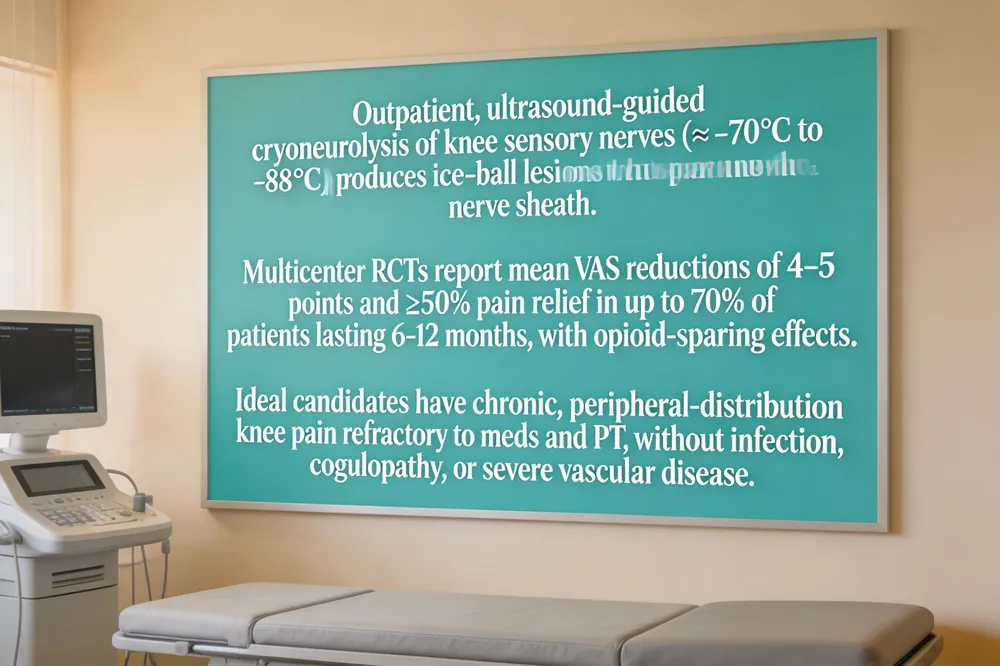 Cryoneurolysis treats knee pain by applying extreme cold (≈ ‑70 °C to ‑88 °C) to specific sensory nerves around the joint, temporarily halting pain‑signal transmission. The outpatient procedure is performed under local anesthesia with ultrasound guidance using a thin cryoprobe that creates a precise ice‑ball lesion while preserving the nerve sheath. In knee osteoarthritis, multicenter RCTs and retrospective series have shown mean VAS reductions of 4–5 points and up to 70 % of patients achieving ≥50 % pain relief lasting 6–12 months, with concurrent opioid‑sparing effects. Ideal candidates are adults with chronic knee pain localized to a peripheral nerve distribution, refractory to pharmacologic and physical therapy measures, and without active infection, bleeding diathesis, or severe peripheral vascular disease. Because axonal regeneration proceeds at 0.5–2 mm per day, sensation gradually returns, allowing repeat treatments if needed. Cryoneurolysis is FDA‑cleared, minimally invasive, and offers a drug‑free alternative for patients seeking durable, reversible analgesia.
Cryoneurolysis vs Radiofrequency Ablation: Which Is Right?
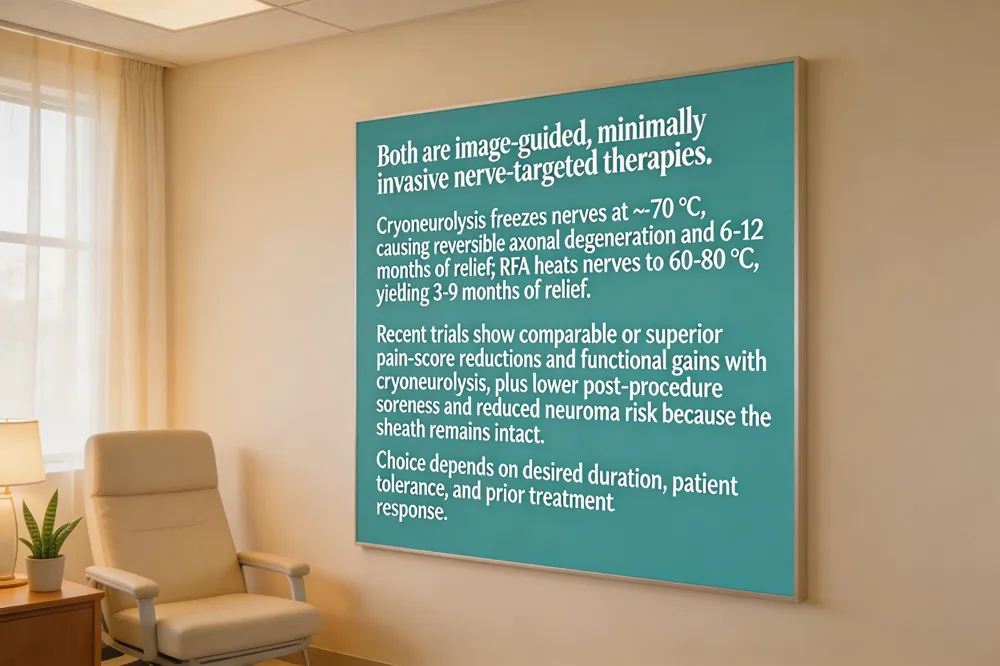 Cryoneurolysis and radiofrequency ablation (RFA) are both image‑guided, minimally invasive procedures that target peripheral nerves to alleviate chronic musculoskeletal pain. Cryoneurolysis freezes the nerve at approximately –70 °C, producing a reversible axonal degeneration (Wallerian degeneration) while preserving the connective tissue sheath; analgesia typically end 6–12 months as the axon regenerates at 1–2 mm/day. RFA, by contrast, heats the nerve to 60–80 °C, creating a thermal lesion that usually provides relief for 3–9 months. Recent randomized controlled trials in low‑back pain and knee osteoarthritis have shown cryoneurolysis to achieve pain‑score reductions equal to or greater than RFA, with superior functional improvements and a lower incidence of post‑procedure soreness or hyperalgesia. Safety profiles are favorable for both, but cryoneurolysis carries a reduced risk of neuroma formation because the nerve sheath remains intact. At the California Pain Institute, cryoneurolysis is often preferred for patients seeking longer‑lasting relief and a gentler recovery, while RFA remains a reliable alternative for shorter‑term control or after cryoneurolysis failure.
Non‑Medication Strategies and the 4 P’s Framework
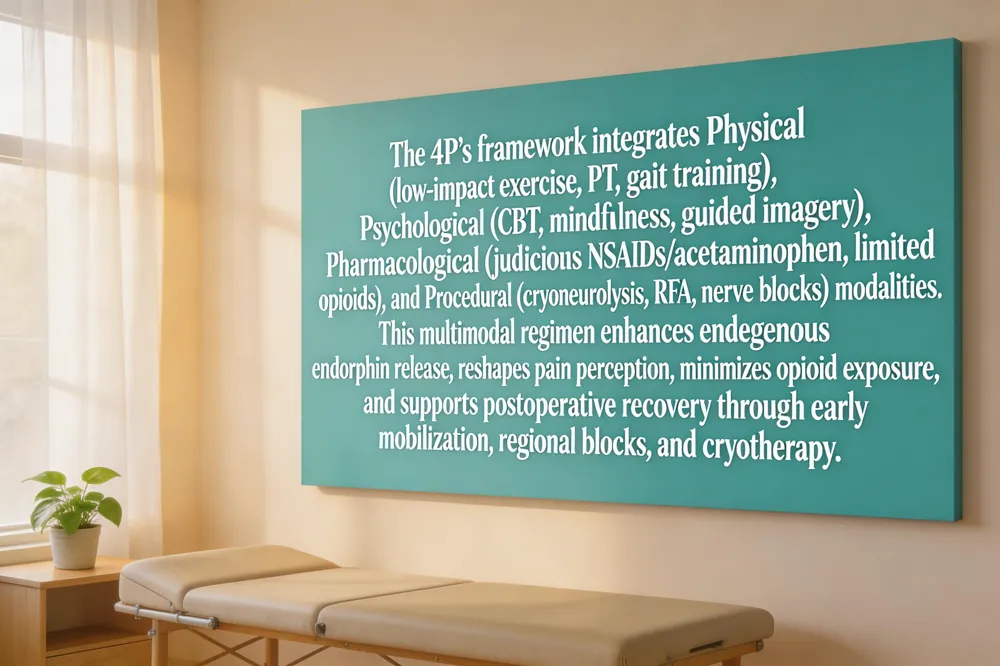 Physical therapy is cornerstone: low‑impact exercise, stretching, and gait training strengthen muscles, improve range‑of‑motion, and trigger endogenous endorphins. Psychological interventions such as cognitive‑behavioral therapy, mindfulness meditation, and guided imagery reframe pain perception and reduce stress‑related tension. Pharmacological considerations focus on adjuncts (NSAIDs, acetaminophen) used judiciously, reserving opioids for breakthrough pain and tapering promptly. Procedural options include nerve‑targeted cryoneurolysis (cryoneurolysis), radiofrequency ablation, and ultrasound‑guided nerve blocks, offering long‑lasting analgesia without permanent damage. Post‑operative pain control benefits from a multimodal regimen—acetaminophen, NSAIDs, regional blocks, early mobilization, and cryotherapy—to minimize opioid reliance. Dr. Kerr specializes in neuropathy, fibromyalgia, sciatica, chronic headache, and back‑pain syndromes, integrating the 4 P’s (Physical, Psychological, Pharmacological, Procedural) into individualized, non‑medication‑focused treatment plans.
Future Directions: AI, Anesthesia, and Cryoanalgesia Advances
 Artificial intelligence is rapidly reshaping anesthesiology by continuously analyzing intra‑operative physiological data to predict hemodynamic instability and adjust drug dosing in real time. Machine‑learning models can forecast postoperative pain levels and opioid requirements, enabling clinicians to craft personalized multimodal analgesia plans before discharge. AI‑driven image‑guidance systems overlay anatomical landmarks on ultrasound, improving the accuracy of regional blocks and vascular access. Predictive analytics also provide early warnings of complications such as hypotension or hypoxia, giving anesthesiologists a vital window for proactive intervention. The future of anesthesia will be defined by these advanced technologies and collaborative care models. Closed‑loop drug‑delivery platforms will automatically titrate anesthetic agents, reducing human error and enhancing safety. Personalized anesthetic regimens, informed by genetic profiles and continuous biometric data, will tailor drug selection and dosage to each patient. Anesthesiologists will increasingly lead multidisciplinary teams, integrating anesthesia into broader population‑health initiatives while maintaining the human touch essential for compassionate care.
Putting It All Together: A Path Forward for Chronic Pain
Cryoanalgesia (cryoneurolysis) delivers targeted freezing—typically –70 °C to –90 °C—to peripheral sensory nerves, creating a reversible axonal block that can relieve neuropathic pain for 3–12 months while preserving the nerve sheath. Evidence from narrative reviews, RCTs, and observational series shows significant visual analog scale reductions, opioid‑sparing benefits, and a low risk of permanent injury, especially for conditions such as post‑mastectomy pain, intercostal neuralgia, and refractory knee osteoarthritis. Patients are encouraged to engage actively in their care: understanding the mechanism, discussing realistic expectations, and integrating cryoanalgesia into a multimodal plan that includes physical therapy and psychosocial support. To explore whether cryoanalgesia fits your pain‑management goals, schedule a consultation with a board‑certified pain specialist at the California Pain Institute today.