Why Insurance Strategy Matters for Chronic Pain
More than 100 million Americans live with chronic pain, a prevalence that exceeds heart disease, cancer and diabetes combined and costs the nation $560–$635 billion each year in medical expenses and lost productivity. Evidence shows that interdisciplinary pain programs—combining medical management, interventional procedures, behavioral therapy and complementary modalities—improve function and reduce opioid use far better than single‑discipline care. Yet many insurance policies limit coverage to medications or a few procedures, leaving patients to shoulder high out‑of‑pocket costs for physical therapy, cognitive‑behavioral therapy or acupuncture. These gaps delay access to effective, evidence‑based treatments, increase disability, and exacerbate the opioid crisis, underscoring the need for comprehensive, parity‑driven insurance benefits. Patients who are uninsured or underinsured—nearly 47 million in 2012—face even greater barriers, often for essential therapies.
Leverage Federal Parity and Medicare Benefits
Key Medicare & Parity Coverage
| Service | Medicare Part | Patient Cost (Typical) | Notes |
|---|---|---|---|
| Physician visits & pain assessments | Part B | 20 % coinsurance after $226 deductible | Covered when medically necessary |
| Physical & occupational therapy | Part B | 20 % coinsurance | Usually 12‑16 visits per year |
| Chiropractic care (low‑back) | Part B (limited) | 20 % coinsurance | Only for chronic low‑back pain with prior authorization |
| Acupuncture (low‑back) | Part B | 20 % coinsurance | Covered under MHPAEA parity for chronic pain |
| Prescription pain meds | Part D | Copay/tiered formulary | Extra Help may reduce cost |
| Massage therapy | Not covered | N/A | Verify with provider; may be covered by supplemental plans |
| Behavioral health (CBT, counseling) | Part B | 20 % coinsurance | Parity requires coverage at medical‑service level |
MHPAEA = Mental Health Parity and Addiction Equity Act (2008).
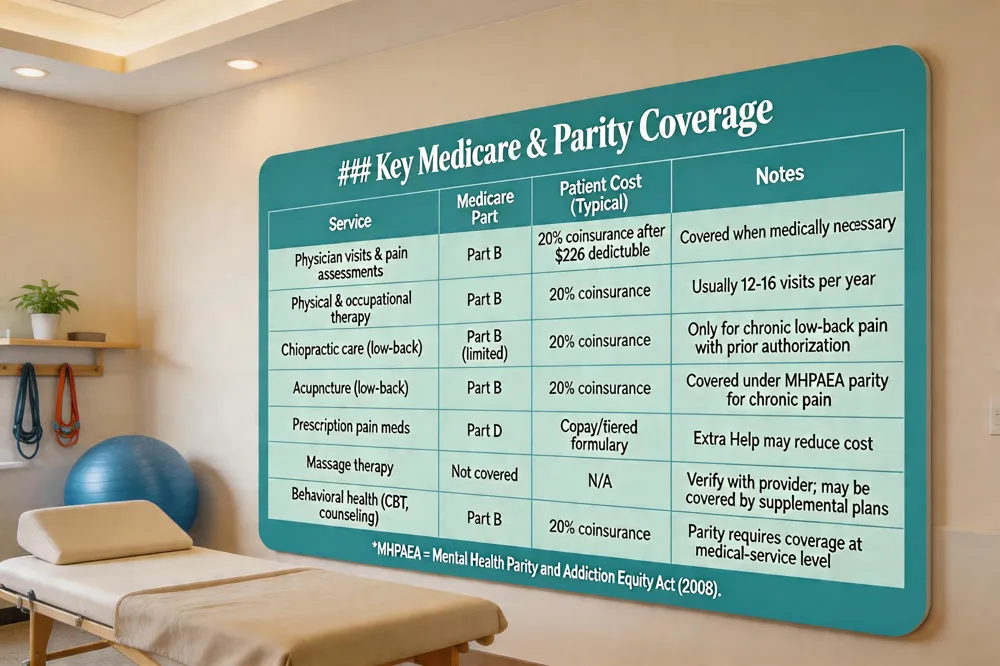 Understanding how insurance works for chronic‑pain care can remove a major barrier to relief. The Mental Health Parity and Addiction Equity Act (MHPAEA) of 2008 requires that mental‑health services—such as cognitive‑behavioral therapy, depression screening, and counseling—be covered at the same level as medical services. AAPM uses this precedent to argue that interdisciplinary pain programs, including behavioral health, should receive comparable coverage.
Medicare Part B pays for many pain‑management services after the $226 deductible: physician visits, pain assessments, medication management, physical and occupational therapy, chiropractic care, and acupuncture for chronic low‑back pain. Patients typically owe 20 % coinsurance of the Medicare‑approved amount. Part D drug plans cover prescription pain medications and often include Medication‑Therapy‑Management programs to improve safety and reduce costs. Some services—such as massage therapy—are not covered, so checking with the provider is essential.
AAPM’s minimum‑benefit model recommends that every chronic‑pain patient receive (1) medical management, (2) evidence‑based interventional therapies, (3) ongoing behavioral/psychological care, (4) interdisciplinary team coordination, and (5) complementary modalities like acupuncture or yoga. Insurance plans that meet these criteria, especially those complying with ACA essential health benefits, provide the most comprehensive and cost‑effective pain care.
If you cannot afford medication, options include Medicare Extra Help, state Medicaid, manufacturer assistance programs, and non‑profit foundations such as the PAN Foundation. The California Pain Institute can help you verify coverage, obtain prior authorizations, and connect you with financial‑assist resources.
Navigate Medicaid, Medi‑Cal, and State‑Specific Benefits
California Medicaid (Medi‑Cal) Pain‑Management Benefits
| Service | Medicaid Coverage (CA) | EHB Status | Typical Patient Cost |
|---|---|---|---|
| Physician visits | ✅ | Yes (EHB) | $0‑$20 copay depending on plan |
| Prescription drugs | ✅ | Yes (EHB) | Small copay; tiered formularies |
| Physical therapy | ✅ | Yes (EHB) | $0‑$30 per visit, limited sessions |
| Mental‑health counseling | ✅ | Yes (EHB) | $0‑$25 per session |
| Acupuncture | ❓ (Limited) | No (EHB) | Often not covered; prior auth may help |
| Chiropractic care | ❓ (Plan‑specific) | No (EHB) | Coverage varies by Medi‑Cal plan |
Check the individual Medi‑Cal plan’s benefits booklet for exact coverage.
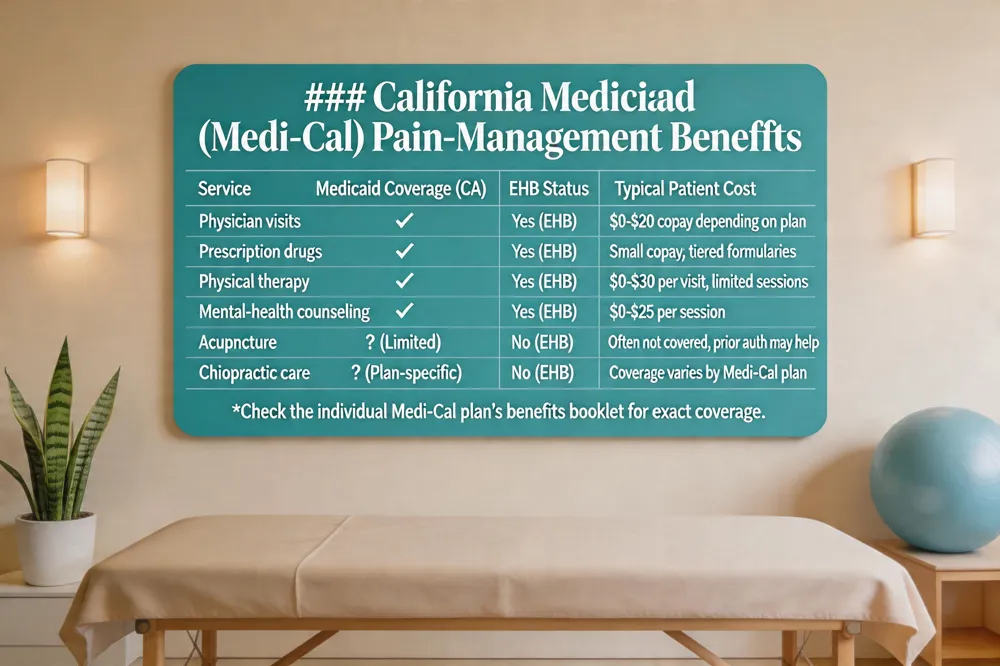 California Medicaid (Medi‑Cal) offers a core set of services for chronic‑pain patients, including physician visits, prescription drugs, physical therapy, and mental‑health counseling. The Affordable Care Act’s essential‑health‑benefit (EHB) requirement forces all marketplace and many employer plans to cover medically necessary pain‑management services, but the inclusion of complementary therapies such as acupuncture or chiropractic care varies by state. In California, acupuncture is listed as an EHB in a handful of states and Medicaid coverage for it is limited; chiropractic care is not an EHB in California, so coverage depends on the individual Medi‑Cal plan.
Pain‑management doctors that accept Medicaid near me – Use the Medi‑Cal provider directory or call local pain clinics. Verify enrollment, as not all specialists participate. A primary‑care referral can help locate a Medicaid‑accepting pain specialist, and the California Pain Institute can assist with insurance verification and alternative payment options.
Does Medicaid cover pain management? – Yes, but benefits differ by state and plan. Medi‑Cal generally covers medications, doctor visits, physical therapy, and mental‑health services; coverage for chiropractic and acupuncture is not universal and should be confirmed with the plan administrator.
Are pain meds covered by insurance? – Most plans cover prescription pain drugs, though cost‑sharing (deductibles, copays, tiered formularies) varies. The California Pain Institute verifies benefits before the first visit and can suggest lower‑cost alternatives or cash‑price plans when coverage is limited.
Choose the Right Provider and Understand Local Options
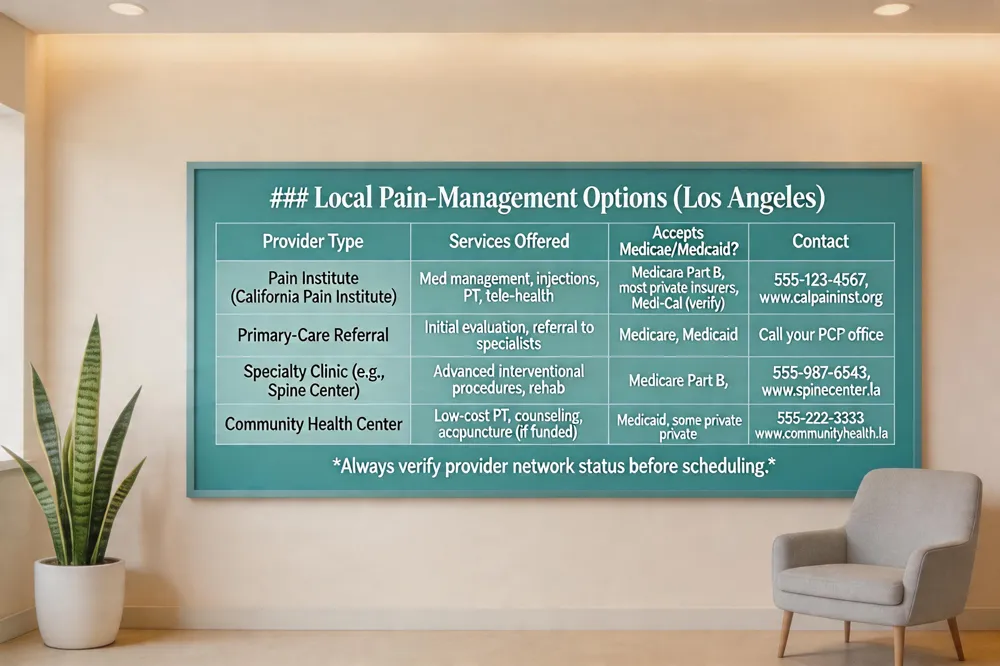
Local Pain‑Management Options (Los Angeles)
| Provider Type | Services Offered | Accepts Medicare/Medicaid? | Contact |
|---|---|---|---|
| Pain Institute (California Pain Institute) | Med management, injections, PT, tele‑health | Medicare Part B, most private insurers, Medi‑Cal (verify) | 555‑123‑4567, www.calpaininst.org |
| Primary‑Care Referral | Initial evaluation, referral to specialists | Medicare, Medicaid | Call your PCP office |
| Specialty Clinic (e.g., Spine Center) | Advanced interventional procedures, rehab | Medicare Part B, private plans | 555‑987‑6543, www.spinecenter.la |
| Community Health Center | Low‑cost PT, counseling, acupuncture (if funded) | Medicaid, some private | 555‑222‑3333, www.communityhealth.la |
Always verify provider network status before scheduling.
 Pain management near me
If you’re searching for pain‑management services nearby, the California Pain Institute in Los Angeles offers comprehensive, physician‑led care for chronic pain conditions. Our board‑certified pain‑medicine physician creates personalized treatment plans that may include medication management, injections, physical therapy, and minimally invasive procedures. We accept most major insurance plans and provide convenient telehealth options for follow‑up visits. Schedule an appointment online or call our office to discuss your symptoms and start a tailored pain‑relief program today.
Pain management that prescribes narcotics near me
California Pain Institute evaluates narcotic use according to strict state and federal guidelines. When opioids are indicated, we use the lowest effective dose, monitor closely for side effects, and integrate non‑opioid options such as physical therapy, nerve blocks, regenerative injections, and behavioral health support to reduce reliance on medication. Coordination with your primary‑care physician ensures safe, personalized care.
Does Medicare cover pain management doctors
Yes. Medicare Part B covers physician services that are part of a pain‑management plan, including chronic‑pain assessments, medication management, and care coordination. After the annual Part B deductible, beneficiaries typically pay 20 % coinsurance while Medicare pays the remainder. Part A may cover inpatient pain‑related care, and Part D helps with prescription pain medications. Verify that your pain‑management physician accepts Medicare assignment.
Best pain reliever for muscle pain
For muscle strain, an over‑the‑counter NSAID such as ibuprofen (Advil, Motrin) is usually most effective because it reduces inflammation and soreness. Naproxen (Aleve) offers a longer‑acting option. Acetaminophen relieves aches but does not address inflammation, making it a secondary choice. Use the lowest effective dose for the shortest time needed and consult your physician if pain persists or you have contraindications.
Non‑Pharmacologic and Complementary Therapies
Evidence & Coverage of Complementary Therapies
| Therapy | Evidence Summary (Key Outcomes) | Medicare/Medicaid Coverage | Typical Use |
|---|---|---|---|
| Cognitive‑Behavioral Therapy (CBT) | Reduces pain intensity & depression (Hoffman 2007; Williams 2012) | Covered under Part B (parity) | Chronic pain & comorbid mood disorders |
| Acupuncture | Improves function in chronic low‑back pain | Covered by Part B for low‑back pain; limited Medicaid | Musculoskeletal pain |
| Yoga | Improves flexibility, reduces pain‑related disability | Generally not covered; may be covered by supplemental plans | Chronic musculoskeletal pain |
| Massage Therapy | Improves muscle tension & stress | Not covered by Medicare; occasional Medicaid coverage | Muscle strain, myofascial pain |
| Chiropractic Care | May reduce low‑back pain severity | Variable Medicaid coverage; not an EHB | Spine‑related pain |
Coverage often requires prior authorization and documentation of medical necessity.
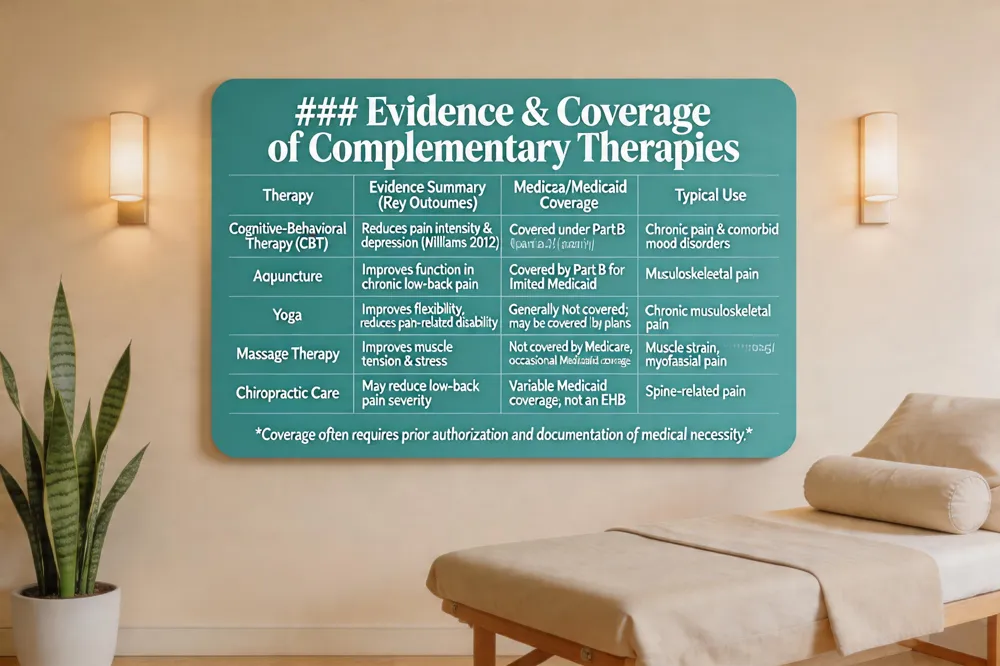 CBT, Acupuncture, Yoga, Massage – Cognitive‑behavioral therapy (CBT) modestly reduces pain intensity, disability and depression (Hoffman et al., 2007; Williams et al., 2012). Acupuncture is covered by Medicare Part B for chronic low‑back pain and by ACA‑mandated essential health benefits in California. Yoga, massage and other integrative modalities improve function and are endorsed by the AAPM as minimum benefits for chronic‑pain patients.
Coverage Variability and ACA Mandates – The Affordable Care Act requires essential health benefits, but coverage for acupuncture, chiropractic and CBT varies by state and plan (WebMD, Medicare). California law mandates insurers cover evidence‑based non‑opioid treatments, yet many private plans impose visit caps or require prior authorization (Pain Treatment Specialists).
Evidence for Interdisciplinary Programs – Interdisciplinary pain programs (medical, interventional, behavioral, complementary) outperform single‑discipline care and sustain benefits for up to 13 years (Patrick et al., 2004). AAPM and MHPAEA call for parity with mental‑health services to expand such comprehensive coverage.
What is the strongest over the counter pain relief? The most potent OTC combo is ibuprofen 200 mg + acetaminophen 500 mg, offering an NNT ≈ 1.6 for ≥50 % pain reduction.
Strongest non‑opioid painkiller for chronic pain? No single drug works for all; high‑dose NSAIDs help inflammatory pain, while gabapentinoids (gabapentin/pregabalin) or duloxetine target neuropathic pain.
Strongest pain killer? Carfentanil is the strongest opioid (≈10 000× morphine) but is veterinary‑only; the next strongest clinical opioid is fentanyl.
Strongest over the counter muscle pain reliever? NSAIDs such as naproxen or ibuprofen, and topical diclofenac 1 % gel (Voltaren), provide the most effective muscle‑ache relief.
Pain‑killer tablet name list – OTC: acetaminophen (Tylenol), ibuprofen (Advil), naproxen (Aleve), aspirin; prescription: acetaminophen‑hydrocodone (Vicodin), oxycodone (OxyContin), hydrocodone (Norco), tramadol (Ultram), gabapentin (Neurontin), pregabalin (Lyrica).
Financial Planning, Appeals and Self‑Management Strategies
Financial & Self‑Management Toolkit
| Tool / Strategy | Description | How to Use | Benefits |
|---|---|---|---|
| Health‑Savings Account (HSA) | Tax‑free pre‑tax funds for qualified medical expenses | Contribute up to IRS limit; use for PT, acupuncture, co‑pays | Reduces taxable income, grows tax‑free |
| Flexible‑Spending Account (FSA) | Pre‑tax dollars set aside by employer | Submit receipts for eligible pain‑management costs | Immediate tax savings, use‑it‑or‑lose‑it rule |
| Bundled‑Payment Plans | Fixed fee for a set of services (e.g., eval + 5 PT sessions) | Ask clinic billing department for package rates | Predictable cost, often lower total expense |
| Insurance Appeal Process | Formal request to overturn a denial | Submit physician’s medical‑necessity letter, supporting docs, track deadlines | May obtain coverage for denied therapy or medication |
| 3 P’s (Pacing, Patience, Persistence) | Self‑management habit framework | Gradually increase activity, set realistic goals, stay consistent | Improves function, reduces flare‑ups |
| 5 A’s (Analgesia, ADLs, Adverse effects, Affect, Aberrant behaviors) | Monitoring checklist for patients & clinicians | Review at each visit or after medication change | Early detection of issues, safer opioid use |
Keep copies of all correspondence and appeal deadlines in a dedicated folder.
 Health‑savings accounts (HSAs) and flexible‑spending accounts (FSAs) let you set aside pre‑tax dollars for qualified pain‑management expenses such as physical‑therapy visits, acupuncture, massage or co‑payments for medication, effectively lowering out‑of‑pocket costs. Some clinics also offer bundled‑payment plans that combine a series of services (e.g., evaluation, therapy sessions, and injections) into a single, predictable fee, reducing administrative hassle and total expense.
Insurance appeals and medical‑necessity letters – If a drug or therapy is denied, ask your pain‑medicine physician to submit a prior‑authorization request that cites clinical guidelines, imaging results and a clear statement of why alternatives have failed. Should the insurer refuse, file a formal appeal with the doctor’s letter, specialist opinions and supporting evidence. Keep copies of all correspondence, note deadlines and follow up with the pharmacy‑benefits manager. If the appeal is still denied, consider a formulary‑covered alternative or enlist a patient‑advocate service.
Patient‑empowerment habits – The 3 P’s of pain (pacing, patience, persistence) encourage gradual activity increase, realistic expectations and steady practice of coping skills. The 5 A’s (analgesia, activities of daily living, adverse effects, affect, aberrant drug‑related behaviors) provide a comprehensive framework for monitoring treatment effectiveness and safety.
Putting It All Together for Affordable Relief
To keep chronic‑pain care affordable, start by confirming that your plan covers the core services you need—medical management, interventional procedures, behavioral therapy, and evidence‑based complementary treatments such as acupuncture or yoga. Use the insurance‑verification tools offered by Pain Treatment Specialists or the California Pain Institute to check network status, pre‑authorization requirements, and visit caps before scheduling appointments. Review your policy’s deductible, copay, and coinsurance amounts every year, and take advantage of HSAs, FSAs, or Medigap plans to offset out‑of‑pocket costs. If a service is denied, submit a medical‑necessity letter and appeal promptly; many insurers will reverse denials when presented with guideline‑based evidence. For personalized assistance, schedule a free insurance‑review consultation with the California Pain Institute—our team will help you navigate benefits, secure authorizations, and explore bundled‑payment options so you can focus on recovery, not paperwork.